Over the years I have learned how to get round large areas of central Paris. My introduction started sixty years ago when Rohan was a student of philosophy at the Sorbonne, and I a medical student in London, and I would go to visit her. When there, she showed me her favourite haunts, and of them it was a walk through the Marais with its narrow winding streets, its tiny shops and restaurants, and its history as Paris’ Jewish quarter to which I became particularly attached. The story of this blog started with a visit we made there late last year.
The Jewish quarter, more precisely the tiny-but-sad square on the Rue des Hospitalières-Saint-Gervais, is where we would find ourselves standing in silence – as we still do – reflecting as we looked at the building that was once a primary school. Here, on the wall of the former school is a plaque that says everything : ‘In the Second World War, 260 Jewish children were taken from this school and deported to Germany where they were exterminated in Nazi camps’. Elsewhere there is more precision, the children were ‘rounded up’ on Thursday 16 July and Friday 17 July 1942 by the French police working with the Gestapo. Ironically, while the children at the school were from Jewish families, the education provided was funded by the state and was secular. In keeping, the then head teacher, a certain Joseph Migneret, was not Jewish.
Another plaque nearby adds a further dimension to the school’s wartime history as it tells of the said ‘Joseph Migneret, who by his courage and risking his own life, saved dozens of children from deportation’. Other plaques tell how he sheltered Jewish children in various ‘safe’ houses and became actively involved in the resistance.
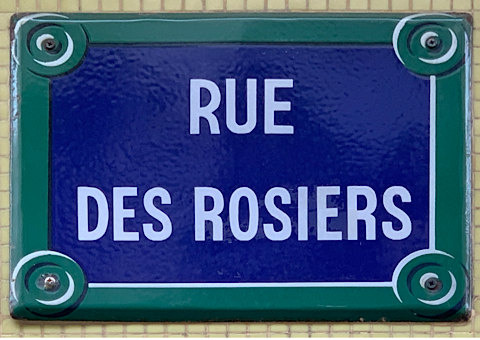
Standing in front of the school and its plaques, unable to do anything but feel miserable and emotionally drained is always dreadful; but on this occasion Rohan and I soon discovered something that eased the pain. Next to the school runs the Rue des Rosiers, (see illustration) a thoroughfare that runs through the Marais and on the other side of the road we found by chance the entrance to a hidden garden of remembrance opened twelve years ago built and maintained by volunteers. Walking through this beautiful ‘Joseph Migneret Rose Garden’ we soon realised that it was actually created as a memorial not just to the Jewish children at the local school but to the 11,400 children from all over France who were arrested by ‘the police of the Vichy Government in complicity with the Nazis and deported from France between 1942 and 1944 to be assassinated in Auschwitz’. Odd as it may seem, for both of us standing in the beautiful garden with its lawns, benches, trees and flower beds, with people around us who obviously shared our feelings allowed us to feel a little less thrown by the horrible past which was still raw following our experience in front of the school itself.
After visiting the rose garden we walked back to the Rue des Rosiers to look for the building that was once Jo Goldenberg’s celebrated Jewish restaurant in which we actually dined two or three times as a young couple. Things at the restaurant changed in 1982 when something terrible happened. At midday on 9 August, five terrorists threw a grenade into the restaurant foyer, then entered the building and opened fire on 50 customers killing six and injuring twenty. Although the gunmen escaped, they were identified by the French authorities and over a period of forty years were chased down. It was an antisemitic incident that rocked France and from which the restaurant never really recovered – finally closing some twenty five years later.
Importantly, in April this year something happened that allowed the awfulness associated with the 1982 attack on Jo Goldenberg’s restaurant to ease a little. Despite the current political turmoils in Palestine, at the request of the French government and apparently as part of a deal in which France would recognise the Palestinian State, the Palestinian authorities agreed to track down, arrest and extradite to France the leader of the 1982 assassination gang – a 72-year old man called Mahmoud Khader Abed Adra. Accordingly, on Thursday 16 April this year the French media told us that Hicham Harb, as the leader is known in France, arrived in Paris where he and four other suspects are now in a prison awaiting trial. It was the discovery of their return and their impending trial that has helped.
Easing the pain of horrors is one thing. That the senseless killing of innocent men, women and children continues all over the world to this day is another. How come humankind seems unable to learn?
The illustration shows a photo of the Rue des Rosiers road plaque on the wall of the former Jo Goldenberg restaurant.
For helping me write this blog, I would like to thank Tom, Rohan and Vivien.

