Just over four months ago, there was a most welcome change in Tréguennec. On 21 March, 2026 to be precise, a new Mayor was elected and in no time the atmosphere in our tiny village with its 326 voters began to change. By two ingenious moves – one domestic, one cultural – Jean-Daniel Mao and his councillors have managed to enhance Tréguennec’s feelings of community and belonging.
We can never return to the bustle of the 1960s when the village boasted a baker, a butcher, a grocer, a haberdasher and a bar. But now, for the first time in years, a step has been taken to regain some domestic identity. Every Saturday morning a stall in front of the Town Hall now sells Tréguennec-grown vegetables. Apart from the ecologically-friendly credentials of the produce, the event brings something of social importance – the stall attracts long queues in which neighbours chat with one another as they wait to be served. Being together and sharing like this feels so right in a village where isolation is a real risk.
The introduction of our Saturday stall is a small but important change. But there has also been the launch of a more extraordinary cultural venture. The Mayor and his team decided that this summer the village would play host to a festival of art. In a refreshing gesture a poster declared a ‘Love of art at Tréguennec’ (« L’envie d’art à Tréguennec ») and until 30 August, the village will be peppered with paintings celebrating twenty years of art at a local centre. This blog is about the works that have now taken over the village and how they have affected me. Importantly, how they have made me question a long-held prejudice.
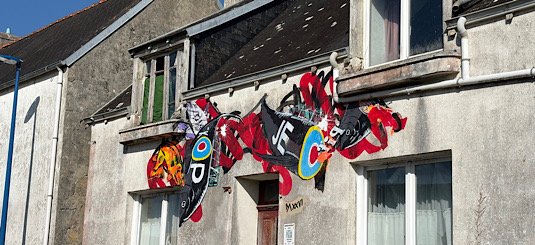
My initial discovery of the village’s summer of art was through an event that actually I found worrying. One early morning, I discovered that a long-abandoned house near us with its broken windows and loose guttering – the owner who lives near Paris has not been for years – had been adorned overnight with what I saw as uninvited graffiti that showed cut fish (see first illustration). Graffitti is an art form I generally dislike (Banksy is an exception) and my immediate concern was that the building risked being taken over by squatters! There was, however, no evidence of such occupation and I was soon reassured when first a close neighbour said she liked what she had seen; then later I read a note giving the name of the artist, and finally when I learned that the painting, as part of the village’s celebration of art, had been both approved and admired by the house’s absentee landlord. This was in fact in situ art.
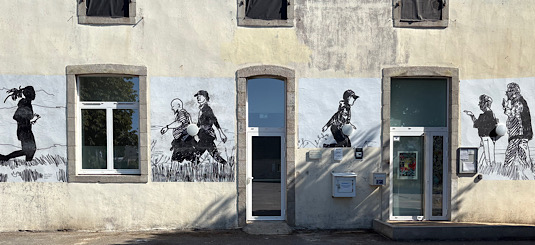
Later that day I saw other paintings, this time a series of seven black-and-white images on a wall of the village Town Hall which showed scenes of people out hiking (see second illustration). My immediate assumption was that these ‘overnight’ works were also uninvited graffitti; there was however something very appealing about the images and I later discovered that these too were planned and signed in situ paintings and part of the exhibition, just like the one on the deserted house !
While the walkers and the cut fish were part of the ‘Love of Art’ event, most of the works were in studios or a gallery, and it was one such work that I fell for (see the third illustration). When the exhibition started I made a cursory visit to the gallery in a deconsecrated chapel and the works displayed offered me little. On telling a friend of my disappointment she told me how I been been too hasty and urged me to go back and look at one particular piece. I did as suggested and this time I immediately fell for the said picture with its refreshing colours, clarity, pattern and border (see third illustration). I just stood and stared and twice returned for more.
Our newly elected Mayor and his councillors have made me think. Their introduction of a vegetable stall which will enhance the village community is ingenious. The art exhibition is a delight and one that has helped me break down one of my long held prejudices regarding wall art – from now on I will look at in situ images very differently. And, by the by, it is interesting how cleverly a delapidated building can be embellished by a mural.
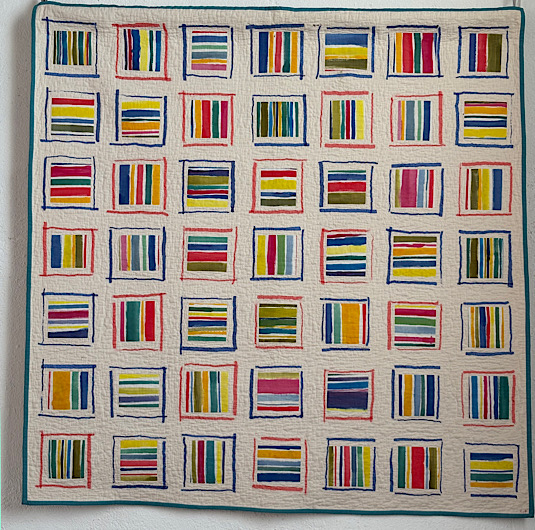
The first illustration shows a photo of the in situ painting on the front of an old abandoned house on one the roads that run through the village. The second illustration shows four in situ images painted on the otherwise blank walls on the front of the Town Hall. The third illustration is a photo of Flag 1, a paint-on-cotton picture I fell for at a tiny exhibition of local art in our now deconsecrated chapel.
For helping write this blog I would like to thank Annie, Dominique, Cosabeth, Yannick, Sarah, Rohan and Vivien.

