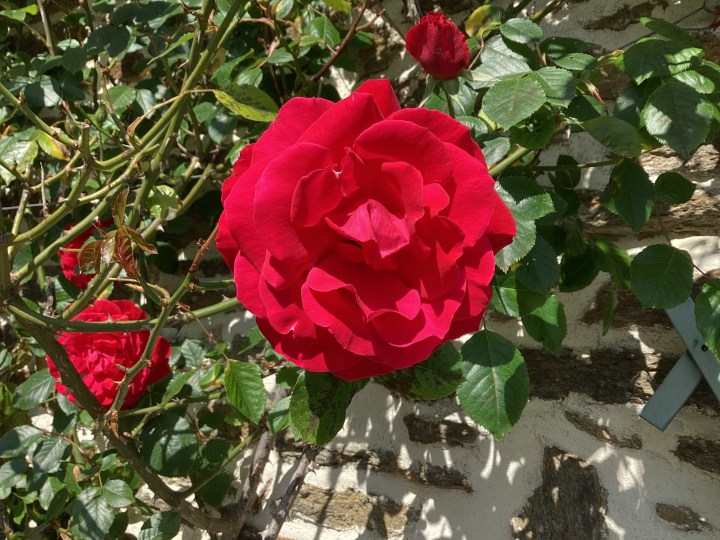
For centuries, roses have been one of the world’s favourite flowers. It is the colour of their petals, their unique fragrance and the form of the flowers themselves that has rightly made them the ‘Flower Queens’. We have six roses growing in our Brittany garden and of these two are very special. This blog is about those two, both of which are now in full bloom (see illustrations).
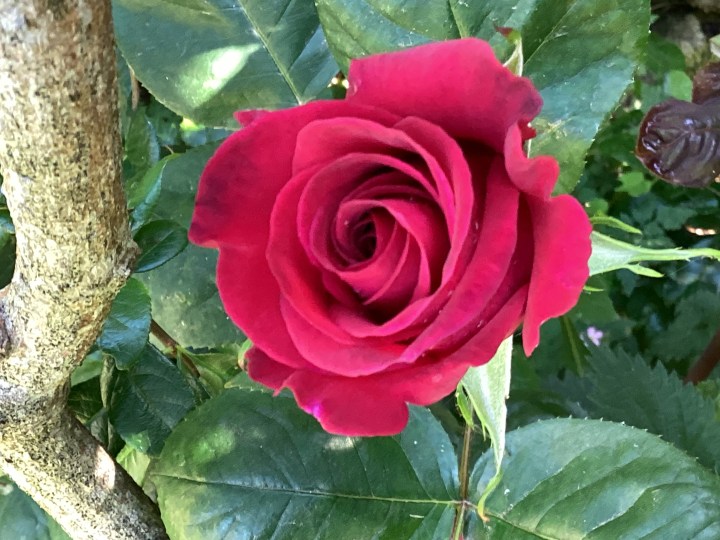
Of the two special roses, one is a thirty-year old climbing rose that grows up the wall beside our back door, and which was already there when we bought the house in 2004. It is an extraordinary plant which each year starts to flower in April and then produces wave after wave of flowers through till October. These flowers, which at any one time can number over a hundred, are arranged in clusters. The flowers themselves are large and pinky-red in colour but now their petals are no longer the neat and tidy form of yesteryear – some even look a bit unkempt (see first illustration). The second rose, which grows as a bush down the garden has only a few flowers at a time and compared to the elderly climber, these flowers are smaller, neater, purple-red (see second illustration) and they arrange themselves in ones and twos. This rose is of great sentimental value as it was planted in memory of our eldest son after his death. ‘Daniel’s rose’ is now thirteen years old.
Importantly, while both roses are much-loved, the two have presented me with a dilemma that is intellectual rather than horticultural. The dilemma arises because the two plants differ from one another in one critical respect; while Daniel’s rose has the most wonderful fragrance, our climber has no smell at all. Significantly, the fragrance of Daniel’s is unique to roses – one which no words seem able to describe!
Such differences in the capacity to produce fragrance are not uncommon and have arisen as an unintended consequence of the genetic engineering that has been undertaken over the last three hundred years. The cross-breeding that has been designed to produce larger blooms, longer thornless stems, increased petal count and greater disease resistance, has resulted in the loss of the scent of many roses. It seems that when genes that code for flower colour are switched ‘on’, the genes for fragrance are switched ‘off’! And it is this ‘advance’ that has caused my ‘intellectual’ problem.
For me the difference in their capacity to produce perfume undermines the key tenet of an adage that I have always loved and held dear. This famous line, written some four hundred years ago, relies on the flowers of all roses having that same wonderful and unique fragrance.
In Shakespeare’s 1597 Romeo and Juliet, Juliet tells Romeo that “A rose by any other name would smell as sweet”. The line is spoken as she tries to assure Romeo that his family name does not affect her love for him; she loves him despite the fact that he comes from a rival family, she being the daughter of the Capulets, he the son of the Montagues.
It is a powerful moment in the play and has since come express a universal truth and a very important message for our times: ‘People or things should be valued because of their essence – for the rose it is their fragrance – rather than for their superficial qualities (labels or appearance). And for me there is far more – it offers an argument against holding prejudices against others based on their appearance as is often the case in racism and sexism!
Here then is an adage of its time which was wonderful then and should still be taken as Shakespeare intended. And it very much depends on what people see as a thing’s essence. In the case of my two roses, no matter their differences or their labels, I love and value our climber for its continued abundance of wonderfully coloured flowers, and Danial’s rose for its fragrance and its profound emotional significance.
How odd it is that two roses could have made me puzzle in this way. The two presented me with an enigma that has taken years to resolve and one that has made Juliet’s pledge all the more powerful.
The first illustration shows a photo of a flower of the wonderful old climbing rose on our back wall. The second illustration shows a photo of a flower on what we call ‘Daniel’s rose’ with its dark red colour and with its petals beautifully formed.
For helping me write this blog I would like to thank Neil, Marie-Vero, Catherine, Rohan and Vivien.

