As a young adult, when friends stayed at our house for more than a few days it raised real difficulties. The problem was that houseguests obliged me not only to be polite and sociable, but also to forgo some of my everyday and precious routines. Accordingly, it suited me to follow an adage which was, or so I thought, written by the eighteenth-century American polymath Benjamin Franklin who wrote that – ‘Guests, like fish, begin to smell after three days’. It so happens that in quoting Franklin in this way I was doing the English playwright John Lyly a disservice, for it was he who, a century earlier and unbeknownst to me, wrote: ‘Fish and guests in three days are stale’!
No matter its origin, ‘Franklin’s’ advice was followed for much of my early adult life, and being host to houseguests for more than a few days was rare. There were occasional exceptions made for family members, for friends who needed a ‘roof over their heads’ and sometimes in return for kindness.
Gradually, my adherence to ‘Franklin’s’ adage wavered and since my retirement – some twenty years ago – in the summer months selected friends, primarily those close, have stayed beyond the originally proscribed limit!
This last week our guest was Jeni and it has been a real treat. She has actually been a regular, week-long, summer guest for over a decade. Rohan and Jeni met in the nineteen eighties thanks to their shared political and aspirational interests. I met Jeni much later.
When with us, whether during discussions over a meal or a cuppa, or during walks or drives through the countryside, it is not long before Jeni, with her encyclopaedic knowledge of nature, starts to tell us something about a plant, a bird, a beetle, her new pet favourites – lichens, or whatever she has spotted and feels we shouldn’t miss . Moreover, if needs be, details are elaborated using her trusty, ever-present binoculars and her magnifying loupe.
In all this, she is able to describe the most complex matters in an interesting and understandable manner. And as part of any dialogue, she rarely forgets to tells us about climate change, with details of its causes and consequences and how it might be reversed. And listening to her as she recounts her stories makes for hours of pleasure.
The extraordinary thing is that Jeni has only acquired this encyclopaedic knowledge over the last 15 years or so. At university as an undergraduate, then during her post graduate studies, then in her lifelong career where issues of equality, social justice and rights dominated, Mother Nature hardly got a look in! But starting a little before retirement, when her circumstances changed, an understanding of nature and the environment became particularly important.
Jeni’s learning about nature is almost an obsession and her insights have come through countless sources, importantly including guidebooks and learned tomes. Added to these she learned by being with some “extraordinary” mentors, by belonging to various groups of nature enthusiasts, by attending seminars or going on courses either ‘live’ or on line, and by exploring the natural world with a guidebook and a birdsong detector close by.
To illustrate Jeni’s knowledge, enthusiasm and generosity of mind, I could have offered dozens of vignettes, but here are two. During a chat on the terrace, suddenly with great excitement she stopped the conversation to point out that above us was, for her, the best of summer sights. Unrecognised by Rohan and I, high in our ‘patch’ of sky ten or so swifts were swooping back and forth in search of insects – seeing this group of swifts was, for Jeni, exhilarating. She then elaborated, first telling us how to distinguish between swifts, swallows and martins and then describing how swifts, who are monogamous, apart from a few weeks nesting, spend most of their lives in flight, eating, drinking, sleeping and mating on the wing. Moreover, she added that they are one of the fastest of flyers in level flight, with cruising speeds of upto 110 km/hour.
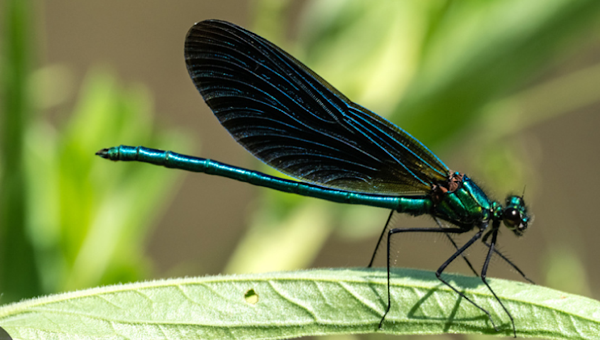
A day later, Jeni spotted an iridescent blue, male damselfly (see illustration) perched on a leaf near our back door – it was looking out for food (mosquitos, mites and the like). This was our first sighting of a damselfly and knowing that, she went on to describe its early life – it only lives a few weeks – when it will have spent up to three years in the mud at the bottom of a pond developing through its larval stages. And of course there were umpteen more nuggets!
Jeni’s stay for several days in Tréguennec with its environmental merry-go-round has been enormous fun. Importantly, it counters the advice of John Lyly and Benjamin Franklin. As is often the case, wise people can be wrong
The illustration shows a photo taken from the internet (none of my photos were so clear!) of a male adult damselfly (a ‘beautiful demoiselle’) whose ‘relative’ we saw perched on a leaf in our Tréguennec garden.
For helping me write this blog I would like to thank Jeni, Rohan and Vivien.


Dear Joe
In Islamic culture, the tradition that guests are welcome for three days (after which they should be on their way) goes way back, as I recall from my time in the Middle East. Presumably anyone staying after that could be a strain on limited resources in nomadic Arab/Bedouin society.
With best wishes –
Tom
Sent with Proton Mail secure email.
LikeLike
Dear Tom, Thankyou for your most interesting comment. Is any explicit reason given for the custom. I imagine that having smells and becoming stale are not amongst them. Best wishes, Joe
LikeLike