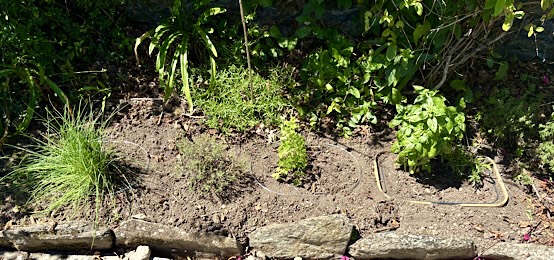
Throughout our life together, Rohan and I have had herb gardens – sometimes near our house, sometimes further away in an allotment. For years these gardens have been her domain; it was Rohan, after all, who first constructed and managed a plot and then, as someone familiar with French cooking, was the main user of their produce. More recently, however, I have become involved, and about five years ago I built, and since modified, a new herb bed in Tréguennec and now I too use its products.
This blog is about this new bed and how we tackled an unexpected problem – initially we could only get about half of the herbs to grow. More precisely, it tells how we overcame a battle against voles who, through their feeding practices were making the bed unworkable!
Over the years two features about herb gardens have become obvious. First, it is much more convenient if the bed is sited near the house – best by the kitchen door; there is something special about being able to pop out while cooking to pick the required flavours. Second, at a practical level, if the earth is of good quality, almost all of the herbs planted grow quickly and at a rate such as to provide a rapidly renewable source of leaves.
Due to an oversight some twenty years ago, our initial Tréguennec herb garden was built well down the garden, and only when parts of the wood of a garden terrace just outside our back door began to rot, was it possible to move it to a more convenient place. But the change required major work. While taking up the rotting planks was relatively easy, the earth beneath – more the gravel, cement and sand – would never have supported plants and had to be replaced. By chance, it was soon clear that our digging had disturbed a new and unexpected animal underworld. We found, and later carefully relocated, two slow worms, a lizard, a toad and a bewildered salamander. What we did not see were rodents, more precisely voles.
With the new bed made, our favourite herbs were planted but while some thrived – thyme, rosemary and mint – many of the others failed. Problems varied ; some plants did grow, some grew then withered, and some seemed to vanish overnight. It was as though they were being dragged back into the soil from under the ground.
After several years puzzling about what exactly was happening under the ground, Rohan realised that first, there was a key factor – amongst the herbs only certain were vulnerable and so died each time they were replanted. Secondly, as the earth in the bed was peppered with the mouths of tunnels, the most likely explanation was these herbs were the victims of tunnelling rodents and on the short list for these were shrews and voles. Thirdly, of these two, the most like candidate was the vole as only these kill plants by tunnelling underneath them and eating their bulbs and root systems. Finally, it is known that voles dislike, and avoid, the very herbs that were spared. Conclusion – the only reasonable explanation is that it was voles who were the cause of our problem. Moreover, since the life expectancy of voles is less than a year, the effects we had been seeing were probably caused by descendants of the voles who lived under the terrace originally !
What was to be done? We tried blocking the tunnels but to no avail. Then, this last spring we replanted all of the vole-vulnerable herbs in soil within sunken stainless steel wire mesh baskets (those normally used as hanging baskets), and it has worked – all the replanted herbs have survived and thrived (See the illustration). Only the top rims of the baskets are visible ; the fine subterranean mesh is providing the protection.
We are amateur gardeners and while our problem with generations of voles would have been diagnosed immediately by the professionals it took us years. Importantly, our solution works for us and won’t have interfered with the place of voles in the ecosystem. Elsewhere they can continue to act as soil aerators, as animals that disperse nutrients through the topsoil and as key parts of the food chain – although mainly vegetarian they eat slugs and snails and are prone to being eaten by the likes of hedgehogs, owls and squirrels.
The illustration is a recent photo of the front of our Tréguennec herb bed. From left to right are chives (within a circular basket rim), some thyme in open soil, some parsley (in a second circular rim), some rosemary behind the parsley and not contained, some basil within the rim of a square-shaped basket next to which is some tarragon. Then, outside and to the right of the tarragon in open soil is more thyme.
For helping me write this blog I would like to thank Alan, Marie-Véro, Jeni, Sarah, Rohan and Vivien.

