When asked which is my favourite season, for as long as I can remember I have said – ‘Spring’. For me it represents a re-awakening after Winter, serving each year as a wonderful reminder of how Nature can come back to life and importantly that nature is indomitable if left to its own devices.
In all this, it is the plant world that each year announces the arrival of Spring. Unfailingly, I am thrilled by the appearance of the tiny, ‘courageous’ snowdrop with stems that appear from under the earth in early February and produce at their tips delicate white flowers hanging like lanterns. And there is more to come as Spring next ushers in pastel coloured primroses, and later, the tall, brash yellow daffodils. For a month or so it is an endless treat.
All this I love. But Spring also brings a re-awakening in the animal world which is an added delight. In many ways the springtime behaviour of animals, particularly birds and mammals is less immediate but for me it presents an added element – their behaviour is something with which I can identify!
This blog tells the story of the springtime antics of two such animals, in fact two robins, who visited our courtyard garden and whose gently discrete response to Spring was a delight and the memory of which I treasure!
I write this from a partisan position – I love robins – and while they are not particularly pretty – for me that description better fits the goldfinch – I see them as inquisitive and endearing friends. Indeed, when it comes to their relationship with human beings, they are indeed sociable. When gardening, it would be unusual if a robin did not land nearby and perhaps perch on the handle of a spade and watch me work. Interestingly, compared to the robins in Tréguennec, Rohan and I have decided that London robins are particularly friendly.
It is through the windows of our conservatory in Richmond that I watched my London robins. Importantly, with this blog’s one exception, what I have seen is consistent with what I have read in bird ‘authorities’.
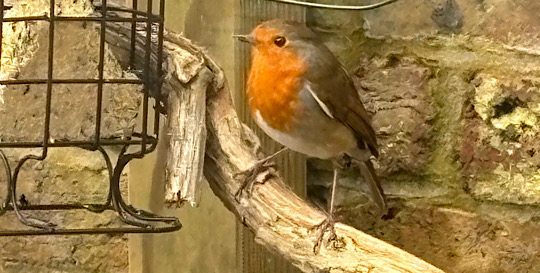
Of particular relevance to one aspect of this story is that robins are fiercely territorial and, accordingly, I have occasionally seen our robin (see illustration), which I have assumed is a male, fiercely guarding his patch (our garden). However, a few weeks ago that territorial drive suddenly melted away when on several occasions he flew into the garden with a companion – no fighting, no squabbling – the two simply hopped around together as close friends. The simplest explanation was that permission had been granted by our robin and, thanks to the season, he had found a mate and they were getting to know each other as part of courtship. Soon they did something that confirmed my view – they performed what I saw as a courtship dance.
Over two days, on three occasions I saw our robin move in a way I had never seen before. Each time, he and his new partner stood facing one another about fifty centimetres apart. He then raised his beak, pushed out his breast and then slowly and methodically swayed his body from left to right, and then back again, in a gesture he repeated twice. The whole dance lasted no more than ten seconds after which the two went about their normal business of feeding before flying off. Interestingly, since those early days he has almost always come to our garden by himself – presumably his partner is involved in nesting duties!
Extraordinarily, in none of the books I consulted and on only two of a multitude of web sites I investigated, was this courtship behaviour mentioned and when it was, it was referred to as ‘rare’. Moreover, it was all new to a close and encyclopaedic ‘birder’ friend. I received a similar response when I contacted the British Trust for Ornithology and spoke to one of their experts who had been studying birds for over forty years. As we spoke he looked through his copy of the birder’s ‘bible’ – ‘Birds of the Western Paliarctic’ – which indeed described the dance adding that it was rarely sighted. On reading this, my expert told that he himself had never seen it and had known nothing of it.
At the end of our conversation this most welcoming and thoughtful ‘authority’ thanked me for my enquiry and said how the dance I had seen was ‘very uncommon’; that my sighting was ‘very special’, and in seeing it I was ‘very lucky’. With his comments, this Spring’s robin-courting discovery has become especially memorable.
The illustration is a photograph of the robin, here alone in our London courtyard who, on three occasions several days earlier had performed a courting dance with his soon-to-be partner.
For helping me write this blog I would like to thank Jeni, Susan, Nick, Rohan and Vivien
By the way, in passing, the Trust’s expert told me how English robins are indeed more human-friendly than those on the continent!
 The Joe Collier Blog
My Rohan, named after your Rohan, recorded a Robin singing on her phone several years ago. Since then she had recorded robins singing from Wales to Cumbria, from Cornwall to Cambridge. When she sees a Robin she plays a song from another Robin on her phone. Every time the resident Robin is intrigued and comes very close, and often sings back. Is it sensing a rival invading its territory? Is it wondering why this particular robin is singing out of season? Or is it wondering about the recorded robin’s accent?
LikeLike
Marvellous blog, Joe, thankyou. Great your robins gave you the special privilege of seeing this courtship dance Vanessa
LikeLike
Dear Vanessa, Thank you so much for your comment. As I said to
Andrea, for me it did indeed feel like a privilege, and one which was particularly specie as the dance was so rare. Love, Joe
LikeLike
Very interesting – I will look out for our Robin’s courting behaviour!
P
LikeLike
What luck and a privelege to see this. It has made me think of paying closer attention to our robins,
LikeLike
Dear Andrea, Thank you for your comment – sorry for the delay in replying. I felt very much it was a privilege but wasn’t sure why.
Love, Joe
LikeLike