A few weeks ago, Rohan suggested we go together to Kew Gardens to see a display of blossom of the rarest beauty. Each Spring, the buds on a now celebrated avenue of cherry trees come into flower and Rohan, who had just seen them with a friend wanted to see them again and hoped I would go with her – the flowers this year were better than ever ! In her proposal Rohan was cautious; she knew that I had a knee that was troublesome and that for me the walk to the avenue would be a real challenge. There followed days of dithering, declining and suggestions that she might go alone but finally we went together and how very right the decision was.
We arrived at the gardens in mid-morning. The sun was patchy as it peeped out between wispy clouds and in its light the blossom was truly magnificent. As we walked along the narrow path that ran between thirty five cherry trees in full flower we were treated to a blanket – more a tunnel – of gently coalescing white that was as beautiful as could be.
And, at the end of the path, a plaque gave us a brief history. We had walked between two rows of Yoshino cherries which in 2017 had been given to the Gardens by a group of cherry-tree enthusiasts in Japan who wanted to promote friendship and peace between Japan and the UK. In Japan, these particular cherry trees are recognised as symbols of friendship.
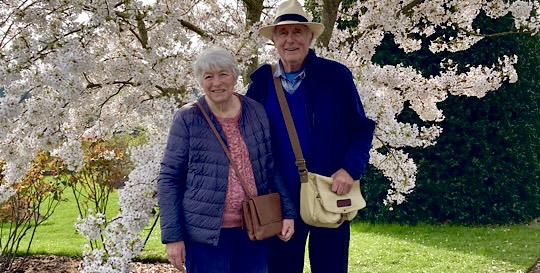
And more beauty was to come. As we left the avenue, we saw a couple – probably in their late twenties – who were taking photos of each other in turn against the background of a cherry tree in blossom. I suggested that perhaps I could use their camera to take a picture of them together and with smiles all round that is what happened. Then, in return for my offer, they insisted on taking a picture of us (see illustration). Not surprisingly, after our impromptu photo-shoot we stood for a while chatting together – an exchange that lasted twenty minutes or so.
Olga and Bulat (my invention, we never discovered their names!) were both from Russia, she from just outside Moscow and he from the countryside near Kazan (Bulat is a name I had heard when I once worked there!). Both of them worked in the world of IT and had now lived in south London for six years. While both spoke English very well, his was unusually measured and precise.
But conversation does not just involve the words used, increasingly there are sensitivities of which one has to be aware. At a personal level, for instance, simply assuming that Olga and Bulat were a married couple was something best avoided. They could both be gay friends living together in a relationship of convenience. Then there is a societal level: just because Vladimir Putin’s behaviour seems so very outrageous to us, it would be wrong to assume that the couple we met in Kew either supported him or despised him. Accordingly we steered clear.
With careful steering by everybody in the conversation from our side, we told them about our many trips to Russia with stays in Moscow, St Petersburg and Kazan; about our visits to umpteen museums and galleries and the occasional concert hall, about Rohan’s grandmother who spent three years there from 1911-1914 teaching young Russian women how to use state-of-the-art textile machinery, and about how for years Rohan has been learning Russian – some of the conversation at Kew was actually in Russian – and with it has developed a love of Russian literature and culture.
What happened next was very moving. Olga, with tears welling up in her eyes, told us how wonderful it had been to meet a couple like us. A couple who have visited Russia, and, turning to Rohan, someone who had chosen to learn Russian, who was aware of the culture and who was not judgmental. Next, speaking through her tears, Olga asked why can’t all people in different countries be so open, kind and understanding? What then followed was inevitable and very touching. Rohan gave Olga a comforting hug and she reciprocated, both staying close for what seemed like minutes.
When Olga’s tears stopped it was time to say goodbye and we parted with no plans to see each other again. It had certainly been an extraordinary meeting. Could the beautifully blossoming cherry trees that surrounded us and which were planted to stimulate friendship and peace between different peoples have done the job? Whatever the explanation, our meeting and our moment’s closeness was an extraordinary and most wonderful occasion! And, by the way, with all the emotion the troubles in my knee temporarily abated.
For helping me write this blog I would like to thank Olga, Bulat, Jo, Sasha, Rohan and Vivien.
The illustration shows a photo taken by Olga of Rohan and I standing in front of one the Yoshino cherry trees in full flower.
 The Joe Collier Blog
Dear Joe. A beautiful story. Moving and uplifting. Thank you.
Love, Andrea
LikeLike
Anne and I always read your blogs with interest, Joe. Today’s is certainly one of the best: a lovely synergy between nature and humanity.
Happy Easter to you both,
Harold
LikeLike
Dear Joe,
Thank you for sharing this lovely exchange in Kew Gardens.
The blossoming cherry trees could indeed have induced the moving conclusion to your chance meeting. The Shinto religion in Japan is polytheistic, fully embracing the natural world, and one of its core principles is believing in the inherent goodness of humanity.
Alan
LikeLike