When I think about famous photographers, I usually know more about the photos they have taken rather than who they are. Obviously, there are exceptions, and one is the American photographer Lee Miller.
Over the last twenty years there have been many attempts at telling Miller’s extraordinary story and of these I have seen four. The first was an exhibition entitled ‘The Art of Lee Miller’ mounted by London’s Victoria and Albert Museum in 2007 to celebrate the one hundredth anniversary of her birth. Then, in 2020, it was the BBC television documentary – ‘Lee Miller: A life on the front line’. Next, in 2023, I watched the film ‘Lee’ that appeared in our cinemas. Finally, in London, I recently saw a fourth assessment – an exhibition at Tate Britain called ‘Lee Miller’.
It was at this last exhibition that I finally felt I understood Miller and was very moved by what I discovered. Moreover, the display of well over 250 exhibits, confirmed how very special she was; here was a most courageous woman who was original, determined, amusing, intrepid and gifted but ultimately vulnerable. And most importantly she was a figure who made a real difference to how we saw many world events in the 1930s and 40s. It is the exhibition at the Tate that inspired this blog.
Miller had a terrible childhood; she was raped at the age of seven by a friend of her parents and then later suffered years of exploitation by her father who photographed her nude well into her teens.
At around eighteen, a hardened and very beautiful young woman escaped the family home to be saved from a car accident in New York by a rich passer-by who happened to own America’s Vogue magazine. Within minutes of seeing her, this total stranger – Condé Nast – signed her up as a ‘Vogue’ model and her new life began.
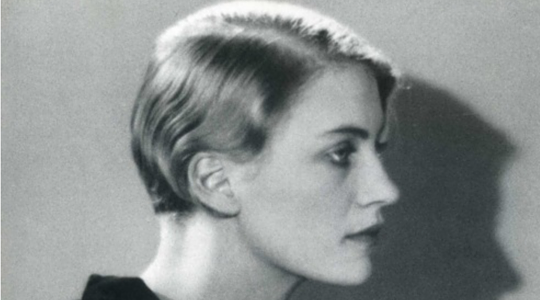
Miller became a celebrated model (see first illustration) but the fame palled and soon she famously said: ‘I would rather take a photo than be one’, and when she was 22 she left for Paris to learn how to be that photographer. She sought out the renowned surrealist photographer Man Ray, hoping to become his student. In response to her approach he declined – he had no time for students. Next day, however, she turned up at his studio and declared that, in fact she would be his pupil! Man Ray changed his mind and so sparking a relationship in which she learned photography; they took photos together, she mixed with his friends who included Pablo Picasso, René Magritte, Salvador Dali, Jean Cocteau, and despite a seventeen-year age gap embarked on an intense affair lasting several years.
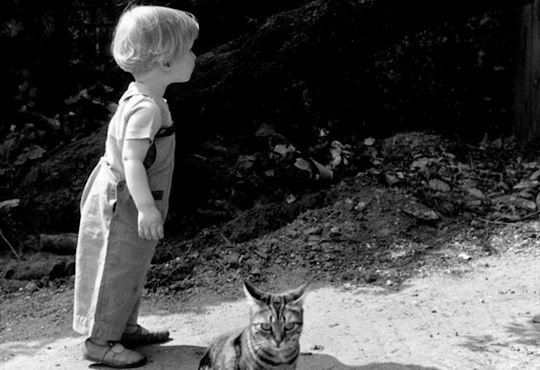
After a subsequent affair with, and marriage to, a rich Egyptian businessman, in 1937, when Miller was 30, she returned to Europe and, in 1939 to London. As a trained photographer, and after finding a new partner, the artist, historian and poet Roland Penrose, an altogether different Miller soon blossomed. Importantly, the two later married and had a son (see second illustration), and she and Penrose went on to live with each other for the rest of her life.
It was seeing the remarkable photos she took during the Second World War that made me realise how extraordinary she was. Working for Vogue, at the beginning of the war she took pictures of London as it was bombed. In her photos she managed to convey the vulnerability, the desolation, the poverty and the pathos of life that random destruction brings. In addition, with great sensitivity she also captured the ironies of war. It is difficult not to chuckle at her surrealist picture of an immaculately dressed model posing in the stone archway of a wrecked building. Similarly, her ‘foreigner’s’ caption written under picture of a grubby and over-complicated set of pipes is perfect – it reads ‘English Plumbing at its most fascinating’.
After four years in wartime London, she crossed the channel to take photos in mainland Europe where, still working for Vogue but now attached to the American army and dressed in its uniform, she photographed the liberation of Paris, Hitler’s now deserted flat, and most harrowing of all, the liberation of the Dachau concentration camp. Importantly she took these pictures specifically as witness to the atrocities, lest the world forgot.
After the War, Miller struggled to overcome the impact of the atrocities she had seen. Most disabling was almost twenty years of depression and alcoholism but even with these she managed to take the occasional photo (see second illustration). At 70 she died of cancer.
The first illustration shows a photo of Miller when a young woman. The second illustration shows a photo taken taken by Miller in 1949 and published in 1955 in the now classical book of photos – ‘The Family of Man’. The picture is of Miller’s son Antony and their pet cat ‘Mrs De Valera’.
For helping me write this blog I would like to thank Jennie, Kaye, Neil, Rohan and Vivien.
 The Joe Collier Blog
Like you Joe, I thought the Tate’s exhibition was a fitting tribute to the remarkable Lee. The home she and Roland Penrose created at Farleys is well worth a visit if you haven’t been xx
LikeLike
Dear Jackie, Thank you for comments and suggestion. I have started planning ways to get to Farleys and think we should get there this Spring.love, Joe
LikeLike
Absolutely wonderful. I’ve read a lot about her, she’s such an amazing woman. Thank you for this. I’m going to reblog it so more people can read this terrific post.
LikeLike
Such a great article about Lee Miller, an extraordinary life. Thank you.
LikeLike
Miller was an extraordinary artist.
Thanks for the post.
LikeLiked by 2 people