As part of a half-term holiday treat, we took our grandson, River and one of his best friends Ava, to see J M Barrie’s ‘Peter Pan’. The play was on at London’s Barbican, and the atmosphere when we walked into the centre’s vast, thousand-seater auditorium, and then looked across to the set on a giant stage showing a four-bedded children’s bedroom, was awesome. Then the play started, it was billed as “An unforgettable journey for all the family” and it turned out to be that and more. Not only did it appeal to River and Ava – out of ten a thoughtful River gave it 9 and a spirited Ava 100 – Rohan and I also found it special as it turned out to be provocative, enlightening and moving.
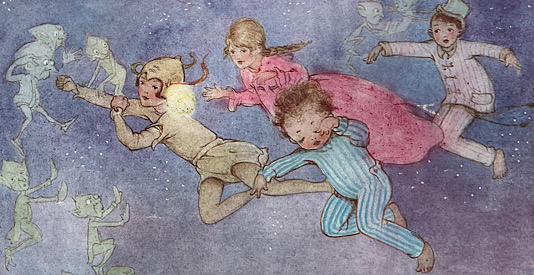
Provocation arose because of the way the play addressed the notion of mortality. Both Rohan and I have grown up with Barrie’s wonderfully crafted story of Peter Pan (the illustration is from the Peter Pan book that Rohan read over and over again as a child and which she has kept safe since). However, in one important way our views of the story that we both ‘knew’ well were very different. For Rohan, the central theme of the play was how the three children of the Darling family learned to fly and with their newly-gained skill and the help of Peter Pan, would fly off at night to play magical games in an imaginary place called Neverland. As befits a great author, Barrie set the scene and with her book’s whimsical illustrations Rohan was carried away.
How different it was for me. As far back as I can remember, Barrie’s ‘Peter Pan’ was a story that had echoes of death, more precisely the death of children. While nowhere in the book is a child’s death mentioned, the fact that Peter Pan, one of the key characters, is a child who never grows old, has meant to me that he has died – after all, once children die, they remain forever the age that is written on their death certificate. And as the children resident in Neverland also don’t age, they too must have died. In some ways, Neverland is a playful haven into which the Darling children are allowed to peep.
Importantly, Ella Hickson’s ‘Wendy and Peter Pan’ – which was commissioned by The Royal Shakespeare Company and first performed in 2013, resolves the matter, as she leaves no space for ambiguity. In an early scene we discover that there is a fourth and rather sickly Darling child called Tom. Initially he is seen playing games with the other children but then one night he dies. The story tells how Tom then flies off to Neverland and much of the rest of the play is about the remaining three children who, led by Wendy, fly to Neverland to say their ‘goodbyes’ to Tom and, hopefully, to bring him home for one last chance to see and hug his parents before he leaves for ever. For me, Hickson’s ingenious twist in Barrie’s story makes perfect sense and it also allowed Rohan and I to share the same position.
The enlightening element in Hickson’s version is how she explicitly converts Wendy into a girl who, by what she does and says, now champions the importance of equality between men and women, boys and girls. Here is a political stance that we both saw as necessary and appealing.
Finally, the particularly moving moment arose when, in the last scene of the play, the now dead Tom, helped by Wendy, makes a fleeting visit to the family home to give his parents final farewell hugs. For two parents who themselves have lost a son this was very moving.
As an aside, there is a real life element that is somehow magical and would appeal to Barrie’s sense of fun. Before his death, Barrie gave the copyright of Peter Pan – both the book and the play – to London’s Great Ormond Street Hospital for Children stipulating that the amount it brought the hospital should never be revealed. Then, fifty years after his death in 1987 when the bequest should have expired, the UK government introduced special legislation to give the hospital a unique privilege; they would have the right in perpetuity to all the royalties from the income that the play brought in the UK. Here then is the exact same notion of perpetuity that Barrie bestowed on Peter Pan himself.
It is unusual for me to be deeply affected by a play but ‘Wendy and Peter Pan’ did just that. The fact that a story originally written for children has, with fine tinkering, been given a universal appeal suggests a touch of genius!
For helping me write this blog, I would like to thank River, Ava, Joshua, John, Neil, Rohan and Vivien.
The Illustration shows a photo of one of Rohan’s favourite pictures (by Mabel Lucie Attwell) in her much-thumbed childhood copy of Peter Pan.


Dear Joe
A touching piece. I too had never connected the story with death (maybe Disney’s influence – I never read the book as a child), and it makes a lot of sense now.
Love from Andrea
LikeLike
Dear Andrea, I am delighted you found it interesting. Love, Joe
LikeLike
I’m with Rohan (obviously), I’d never made the connection with death either. The metaphorical death of childhood theme, yes, but not death as in the end of life. But good story telling should leave room for interpretation, just like in life. I’m interested to know whether the kids picked up on the theme, and how they responded? I love the story of the bequest too.
LikeLike
Dear Rohan (2), Thank you for your kind comments. You are right, stories often have sub plots! Love, Joe
LikeLike
Hi Joe,
What a wonderful blog post. I’d never thought of the story like that. I thought it was about children in a care home, who had no parents, and then wonderful things happened, following sadness and loneliness. Thanks for a wonderfully-written blog post that has got us thinking and talking.
LikeLike
Dear Mis, I enjoyed reading about your original interpretation and pleased to find that you feel mine seems to work better. Yours, Joe
LikeLike
Thank you for your enlightening blog Joe and for reviving some of the story of Peter Pan for me. It’s wonderful to know that all royalties from income from the play in UK goes to Gt Ormond Street Hospital which has a special meaning for us.
Movana
LikeLike
Dear Movana, Thank you very much for your comments. I am so glad it gave you some new ideas. Yes, the story of how Barrie helped to support Great ormond Street Hospital is indeed heartwarming for all sorts of reasons. Love, Joe
LikeLike
Very interesting blog Joe.
I had never thought of Neverland as being anything other than a playful fantasy for children but now , although not a believer in the afterlife or heaven and hell (except on earth in our lifetimes), your story has shown me another interpretation perhaps intended by J M Barrie – that of Neverland being the place where children go when they die, and how his story allows Wendy and the other children to reconnect with loved ones, in a happy place where they are forever young.
I was also delighted to learn that the Great Ormond Street Hospital for Children benefits from the royalties of Peter Pan in perpetuity (appropriately). I can also understand why they perhaps do not make too much of it – given the above interpretation of Neverland.
Best wishes,
Anis
LikeLike
Dear Anis, Thank you for your thoughtful comments. It is quite difficult to know how to deal with my interpretation. I am sure Barrie will have had the death idea in the back of his mind but ingeniously hid it. As for his generosity with regards to GOSH, his was a wonderfully thoughtful gesture and that it continues is so appropriate. Love, Joe
LikeLike