This story began in the dining room of a country house near Antwerp. There, in 1566, the owner, Niclaes Jonghelinck, displayed his set of six, wonderfully detailed landscapes which, amongst other things also illustrated the ‘hard work of the peasants, the dignity of their labour and the central role of nature in their lives and livelihoods’. Each picture was set in a different season and to paint them Jonghelinck, a wealthy local businessman, commissioned Peter Bruegel the Elder; at the time Bruegel was at his peak. Of the six ‘Seasons’ five survive; the sixth, ‘Late Spring’, has been lost.
Recently, around four hundred and sixty years later, as if by magic I found myself marvelling at all six pictures as once again they hung together, but this time they were on the walls of a tiny gallery at PhotoLondon. Much trickery had been used by the artist Emily Allchurch who, with the help of the latest computer technology had ‘reproduced’ each of Bruegel’s ‘Seasons’, including the lost ‘Late Spring’ which she created herself, and in doing so had also brought each up-to-date!
Rohan and I had been invited to view the display by a friend who helped run the gallery but before we saw it, we first we walked through the exhibition’s giant marquee set up in the courtyard of Somerset House and then through umpteen of the Palace’s side rooms.
The exhibition was vast and most of the photos were extraordinary. Whether black and white or in colour, the clarity, the detail, the images themselves were a match for anything I had seen before. And, as a treat, tucked away in one of the Palace’s smaller rooms was a display of original mid twentieth-century works by the American photographer Lee Miller and her French counterpart Henri Cartier-Bresson, both of whose works I adore.
However, there was a problem: in the Marquee there also ‘modern’ photos where the images had been manipulated and distorted and so whereas, by tradition, pictures taken by cameras ‘never lie’, here the rules had been broken and distortion was rife. In my mind a picture taken by a camera can and should only create images that are representational. In other words, the details seen in the picture should exactly echo what would have been seen by the naked eye and for that reason can be trusted.
Initially, when I felt that a work was a distortion, I simply walked by. But then I found myself in front of Allchurch’s digital photo-collages and although there were distortions, somehow it did not matter and these pictures changed my mind. Here the tricks used had created new images and it worked, indeed, for me at least, here was a new ‘photographic’ art form that I found fascinating, even captivating.
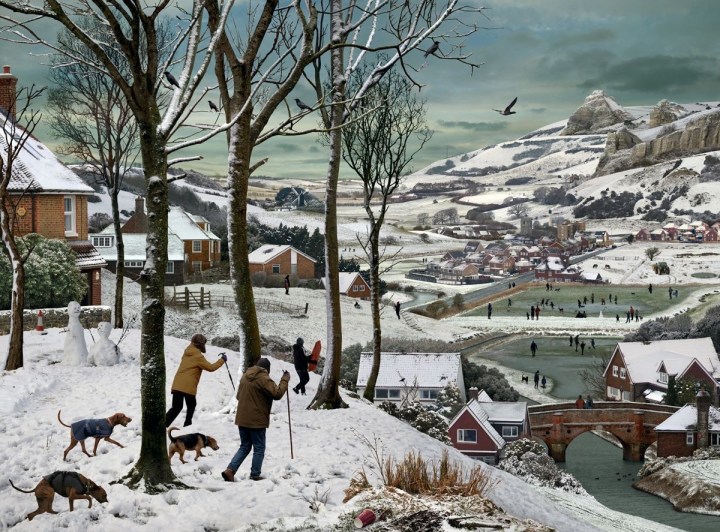
In each of her pictures, Allchurch had used a photo-editing programme to creat her collages with which she was able to imperceptibly blend-in portions of thousands of her own photos to build up new pictures. Her starting point was each of Bruegel’s ‘Seasons’, which included ‘her’ sixth. Ingeniously, with her ‘morphed in’ elements, she created a new ‘canvas’ where she essentially replaced every aspect of Bruegel’s picture, including the images of birds, branches, houses, mountains etc that he had originally created with his paint brush. It was when she used modern images that Allchurch took the liberty of making ‘updated’ versions of Bruegel’s originals while matching them for size, colour, arrangement and ‘feel’.
Allchurch’s updated version of ‘Winter’ is shown in the first illustration and a photo of Bruegel’s original is seen in the second illustration. In her version the houses, the dropped litter, the sled, the traffic cone, the road already cleared of snow are part of modern life, while the trees, the birds, the valleys and hills, and the ice-covered lakes are timeless. Interestingly, she lists with each of her pictures the source of her images, and for ‘Winter’ these came from photos taken of the South Downs, Eastbourne (Butts Brow), and Brede Valley in East Sussex.

It is the case that through her camera techniques, and with no excuses, indeed with much pride, Allchurch has created something false. However, while the pictures on display are once removed from Bruegel’s original, they are certainly recognisable as ‘updates’. Moreover, as they are her re-interpretative collage, using her own photos, the pictures are somehow true to themselves. Interestingly, while her montages are ingenious, fascinating and certainly eye-catching, it is no surprise that they do not truly impart the immediacy and feeling of Bruegel’s originals. But, of course, such an appeal is one of the reasons Bruegel is so famous.
The first illustration shows a photo-montage by Emily Allchurch created in 2024 using computer technology that brings Peter Bruegel the Elder’s ‘Winter’ up-to date. The second illustration is a photo of Bruegel’s original ‘Winter’ painted in 1565.
For helping me write this blog, I would like to thank Sasha, Giles, Tracey, Rohan and Vivien.


You might be interested in two other visual ‘updaters’ in the decorative world, Timorous Beasties and Brextware. Here are links to examples:
https://www.timorousbeasties.com/view-product/edinburgh-toile-wallpaper
https://www.facebook.com/brexitware/?locale=en_GB
LikeLike
Dear Sarah, Thank you so much for your two links. Love, Joe
LikeLike
Interesting blog – fascinating how new technologies can enhance creativity !
LikeLike
Dear Anis, for me too the work provided a fascinating discovery. Yours,Joe
LikeLike
I love the modified Bruegel, particularly the PVC windows and the burglar alarm.
For something even more zany, check our James Johnson-Perkins and his concept of ‘gigatage’: Monty Python meets Bosch;
visualartjournal.com/2024/09/16/james-johnson-perkins/
LikeLike
Dear Stephen, Thank you for comments and suggestions. Also thanks for pointing out the burgar which I completely missed. Here modernisation has some amusing elements. Yours,Joe
LikeLike