
This story started over thirty years ago. Jeff, the brother of one of Rohan’s oldest childhood friends – phoned us to ask a favour. We had a large house in London and he wanted to store some antique pottery with us. His story was complicated. He had just come over from Chile – he lives there for a large part of the year – and had shipped with him five metal crates of antique Peruvian pottery. In his capacity as a businessman, he had brought the goods to London hoping to sell them for a good price. However, laws had just been introduced world-wide that made for difficulties. To be allowed to sell antiques outside their country of origin, sellers would need to provide documents giving the provenance of each and every item, and for one reason or another he had no such documents.
While he was exploring ways by which he might get round the new laws, he hoped we could temporarily look after some of his collection, and after much discussion and some reticence we agreed. Two of his padlocked crates were then taken to our basement while the remaining three were deposited in a storage warehouse. A few days later he returned to Chile.
Jeff was well known as a hoarder and a person who would regularly leave acquisitions in relatives’ houses. Moreover, those looking after his books, paintings, sculptures, boats or whatever soon discovered that persuading him to come and collect them rarely worked.
And that is exactly what we experienced. But first things got worse: when we moved house, since nothing had happened in response our attempts to get Jeff to remove his pottery, we found ourselves taking the crates with us. Interestingly, we learned from the storage warehouse that it had been obliged to dispose of the crates he had left with them. Despite several requests to him to pay his storage bills, no money arrived and, as we understand it, the locks of his three crates were broken, the crates were opened and the contents unceremoniously dumped!
Last year, we too finally lost patience, and decided it was time to rid ourselves of the crates and their contents. Our approach was simple: for the umpteenth time we would write to Jeff but this time we would give him a deadline by which they should be collected. Moreover if they were not collected we reserved the right to negotiate ways of sending them back to Peru. During the correspondence a new date was fixed but to no avail – with neither an explanation nor an apology, Jeff did not appear and we were again left with his crates.
The Peru idea turned out to be complicated. Through an intermediary familiar with Peru and its antiquities it soon became clear that sending our two crates sealed was not an option: the works we had would have to be displayed, photographed and ‘verified’ first. The padlocks were duly broken and one by one over thirty pottery artefacts were taken from their wrappings and laid out on a bed (see first illustration). For me, it was the first time I had seen them despite having ‘looked after’ them for all those years – when they had initially arrived it was Rohan who saw them all.
The pottery objects made for an eclectic collection. They were mainly painted pots and jugs that would have held water or perhaps oil. Most were based on animals and very often were adorned with shapes of a phallic nature! In addition there were pottery dolls. Of them all, my favourite was the equivalent of a Toby jug (see second illustration).
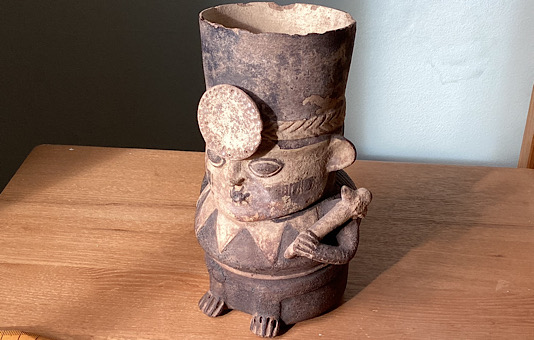
After correspondence with the Peruvian Embassy in London and a senior Curator at the Museo de Arte de Lima in Peru, we quickly learned that the sculptures were indeed genuine Peruvian antiquities dating back over 500 years (‘Precolumbian’). More importantly they were lauded as a ‘fantastic and most valuable collection’. And while they were not of the quality to be exhibited in the country’s main museums, for the richness of Peruvian heritage their return would be greatly welcomed and in this the Embassy was willing to help.
Within a week, a chauffeur from the Embassy came to our house and with gloved hands picked up each piece and re-packed them in their crates. Next, they were driven to the Embassy in a limousine, and I have just discovered they are now on a boat sailing home.
For over thirty years, and unbeknownst to us, we had been the guardians of antique Peruvian treasures. Engineering their return home has given us enormous pleasure.
The first illustration shows a photo of some of the pre-Colombian pottery that had belonged to Jeff now laid out on a duvet and ready for their return to Peru. The second illustration shows a photo of a pre-Colombian Toby jug – my favourite.
For helping write this blog I would like to thank Jeff, Armando, Hilary, Irina, Anne-Marie, Sarah, Rohan and Jenny.
´
 The Joe Collier Blog
What a great story, Joe, and what fantastic pre-Columbian artefacts. If you and Rohan weren’t such upright citizens, you could perhaps have kept Mr Peruvian Tobyjug as a small reward for all those years of storage.
LikeLike