
In France and England, and probably everywhere else, whichever china is used for everyday meals, tradition dictates that on special occasions the table is set with the household’s best set. Not only does such an arrangement tell guests that for them the meal is to be a special occasion with a menu to match, it also happens, or so it is said, that food tastes better when served on and eaten from a matching set of ‘classy’ china without stains, cracks or chips.
With breakages, sets of china gradually become depleted and replacements have to be found. This blog tells of the arrival of twenty-six new plates, all of which were ordered specially for us. However, while those plates delivered to our London home – ten large and ten small – provided us with a completely new set, in Tréguennec the six new small side plates were brought in to help us build up a set of china that we had been slowly collecting over around ten years. In both homes, the arrival of the new plates was greeted with celebration.
Importantly, in our two homes, we use our chinaware differently. Moreover, in London we break with tradition – we have never had two china sets to choose from! Accordingly we have always used one set good enough to be used for both formal and family meals. With such an arrangement, our sets have needed replacing every ten years and it is just such a change that we have now made.
A local potter came to see the plates that were to be replaced and with her we decided how we wanted the new set to look. We wanted two sizes – one main, one side – and were keen that they should be the same grey-green colour as their predecessors. We also agreed on the shape and height of the rims. Jo took notes and made drawings and three weeks later all twenty – well all but one which was still in the kiln – arrived. They were just as we had hoped, and seeing and touching them was a delight. Soon they were arranged in a plate rack (see first illustration) and those being replaced went off to their new homes with different family members – some for use as plates, some to be broken up and laid as mosaics!
Now to events in Tréguennec. There, our use of table settings is more traditional; we have two sets, one for family meals and the other in the throes of being developed for use on special occasions. However, until now there has been a problem – our ‘smart’, lime green set has been far from complete; it needed small side plates. It happens that this set of chinaware has been made by a local potter and commissioned through a ‘kitchen’ shop in a town an hour’s drive away.
Last year we asked the shop to order for us six, much-needed side plates of the selfsame colour as our larger originals. However, we heard nothing and last week, after seven months, we drove down to see what had happened. The shop assistant looked through her order book, went off to the storeroom and there she found our order on a shelf in the wrapping in which it was originally delivered from the pottery!
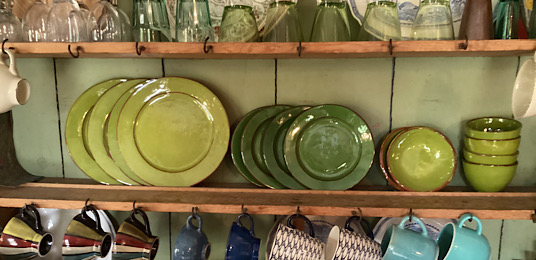
She opened the packet in front of us and it was an amazing moment: although we realised that the green of the plates was darker than that of the originals, their style and form were clearly of the same set (see second illustration). At last we would have a ‘smart’ china set for entertaining in Tréguennec albeit with colour differences that we were happy to accept. When replacing broken items of an antique china set it is often the case that the replacements are not quite the same shape or colour. If that is acceptable for antiques, why should it not hold for modern sets!
In our family, there has always been something very important about the chinaware off which we eat. Sometimes the sets have been family heirlooms, sometimes bought or received antiques, sometimes completely new,
but whatever their origins they are treasured and loved and only replaced with great care. The last month has been a period in which our chinaware has changed, and the outcome of the changes has made me both delighted and relieved.
The first illustration shows a photo of our new ‘London’ dinner and side plates standing in our plate rack. Ten plates of both were ordered; but the tenth of the smaller plates is still to come. The second illustration shows a photo of a selection of the china of our ‘best’ set in Tréguennec displayed in our old kitchen dresser. The new, apple green smaller side plates are obvious.
For helping me write this blog, I would like to thank Jo, Jeanne, Sarah, Rohan and Vivien.


What delicious dishes. Thanks for the beautiful old ones for my mosaics. I will let you know when and where they appear!
LikeLike
I really like your Treguennec plates. I have found it difficult to find ready-made plates that I like. You’ve given me the idea to find someone local who can make them!
LikeLike