If I have learned one thing as a blogger, it is that any single word is only half the story. In reality, what precedes and what follows helps determine that word’s full meaning. And, added to words in the text, there are also more distant determinants; with a book for example, there may be the politics of its author and the circumstances of its publication. Just as for words, the same applies to works of art. For paintings or sculptures for instance, context can make a real difference.
The role of context has been puzzling me for years; recently, however it’s importance has become clearer. As a writer, the new clarity has come by a detailed study of some recent postings. For works of art, it was the film ‘Van Gogh: Poets and Lovers’ that helped clarify matters. Interestingly, context in the two art forms presents itself differently.
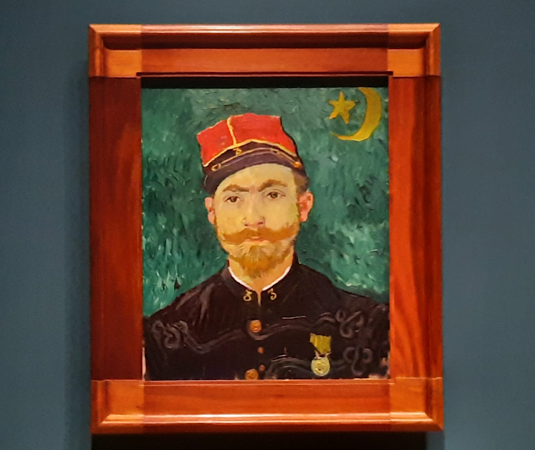
Starting with works of art, here context can both belong to and surround a piece. Importantly, what one sees when looking at a painting or sculpture for the first time – that first impression – often comes without a thought for context. Then, perhaps almost immediately, context may influence the viewer’s mind and change perceptions. Van Gogh’s wonderful portrait of Lieutenant Milliet, painted in 1888 (see illustration), well illustrates ways in which context contributes.
Paul-Eugène Milliet, a French-Algerian soldier became close friends with Van Gogh when, for several months, he was stationed in barracks close to Van Gogh’s home in Arles. It was then that the portrait was painted which subsequently became one of the artist’s favourites.
The portrait has ‘internal’ context, created by the rhythm of the artist’s brushstrokes, the sitter’s pose (Milliet’s dreamy eyes, his flamboyant ginger beard and moustache and his jaunty-angled hat), and the colour of the background. Next, there is the portrait’s ‘external’ context of which the most immediate is the curious, ‘arts-and-crafts’ frame with colours that echo and embellish the colours of Milliet’s hat and whiskers. Added to this, the gallery has created context by introducing a grey-green wall on which the portrait hangs.
Finally, here there is another level of context and one that is intriguing; Van Gogh has named the portrait – ‘The Lover’. The obvious explanation for the title is that Van Gogh wanted to reveal the identity of his lover. Yes, they were indeed close friends, spending much time walking together and sharing ideas, but this was probably all. While an erudite and a wonderful painter, Van Gogh’s private life was tumultuous and when it came to relationships, difficult. With women particularly Van Gogh was gauche, and he saw Paul-Eugène as so at ease and successful that through the title he seems to pay homage to a man he saw as their perfect lover and invites viewers to share his admiration! For me, it was not possible to see the picture without being affected by the title, and as with other external contexts it influenced my judgement greatly. For many, context will help determine the portrait’s appeal but how it works will vary from person to person.
Back now to writing, well my writing, and the place of context. Through the eight hundred words of each blog I try to produce a message that goes unadulterated from my mind, via the printed word, into the reader’s mind with no place for ambiguity, misunderstanding or misinterpretation. Yes, the reader may put their own ‘spin’ on the story, so add their own external context but, through the piece’s precision I strive to make the blog’s internal context difficult to alter. And, importantly, because of this precision, each word plays on the others and in so doing defines them.
This issue of defining is important. In Lewis Carroll’s ‘Through the Looking Glass’, Humpty-Dumpty, who saw himself as an expert in English grammar, told Alice ‘When I use a word, it means just what I choose it to mean—neither more nor less’. For years his assertion appealed to me, but now my position has changed with my realisation that the definition of each word, in my text at least, is indeed very much the product of its context.
In art, the role of context is important and the part it plays depends on the reader/viewer and on the author/painter. I see Vincent Van Gogh as a troubled genius and his portrait of the Lieutenant a masterpiece with internal context embellished by its surrounds. For my blogs, context is delivered by the text and it is for you, the reader, to add your own ‘take’. Moreover, how I write now suggests that Humpty Dumpty was wrong!
The illustration shows a photo of the portrait of Lieutenant Milliet, painted in 1888 by Van Gogh and which he entitled – ‘The Lover’.
For helping me write this blog I would like to thank Sasha, Sarah, Rohan and Vivien.
 The Joe Collier Blog
Another very thoughtful and thought-provoking blog, Joe. Thank you. Lots to consider here and chew over when we next speak, perhaps. Love to you both and hoping that your mobility is improving by the week. JJ X
LikeLike
Dear JJ Fruitbat, thank you for your kind comments. I look forward to some detailed discussion in due course. Love, Joe
LikeLike
I’ve read this blog a few times, and I think I need to to see the film… my simple brain took me back to Winnie the Pooh; each character meant what they said, no room for interpretation and everyone knew what they meant and respected each others views. I so enjoy your take on life, issues and the most peculiar of situations, as for Van Gogh and Paul-Eugène Milliet… I hope they had a most fabulous love affair.
LikeLike
Dear Carolyn, Thank you for some very special comments. It would have been wonderful if Van Gogh had had a successful love affair but I suspect that it was beyond him. As for Winnie the Pooh, it is because we know the context that Poohs observation that “Those who are clever, who have a Brain, never understand anything.” is so touching. Love Joe
LikeLike