I am an inveterate challenger and this blog tells about two occasions when I was at it again.
I have actually been challenging for years. At school, I challenged teachers or fellow students when I felt that they had said, or done something I saw as wrong. Later, challenging was a central part of my career. As a researcher, I sought new information that would challenge contemporary science and understanding. As a specialist in drug policy, I would challenge government, academia, the medical profession and the pharmaceutical industry if I discovered that something was unjust.
I have never understood why I challenge so much, but my position was actually reinforced in my late fifties when I saw the threat of the birth of ageism. Young professionals were beginning to discriminate against those older, seeing them as out-of-date, unreliable, and even irrelevant. Moreover, since such discrimination might soon have affected me, I explored ways by which its effects might be avoided.
My approach was straightforward – I looked for examples of older people who had defied being stereotyped; I then analysed their behaviour to identify the characteristics they had in common that might have helped them defy ageism and which I could adopt.
I found two such defiers, both were now dead, both of whom had been my heros and both had lived into their nineties. Importantly, right to the end, they were listened to and continued to be admired, influential and respected – the two were Nelson Mandela and Bertrand Russell. Now to what had they in common – both never stopped challenging. With this discovery, it seemed that I should continue my own challenging ways.
Both of my challenges in this blog took place during a recent trip to Paris. The first involved two police officers on patrol in the Luxembourg Gardens; the second a walk on a pristine lawn.
The purpose of the first was to challenge a senseless phobia of the police widespread amongst the French, a position so different from my experience in the UK. A year ago I was standing in a London airport lounge when two armed, uniformed police officers passed nearby weighed down with weaponry. We exchanged nods and smiles and I asked them ‘What’s business like?’ They said ‘So far all’s calm’. Then, after a short chat about where I was going, they left, still smiling, and wished me well; in return, as they walked off I thanked them for the work they were doing.
In France, such an encounter would have been unimaginable. There, the public are fearful of the police to the extent that they avoid eye contact – after all, for showing insolence one could be arrested, even imprisoned! And by their expressions and mannerisms the police play along with the public’s fear and for this reason challenging their bullying position was important.
As Rohan and I strolled through the Gardens, two heavily armed policemen walked towards us just as had happened in London. I went up to them, said my good mornings and told them that I had noticed that while one was cradling a rifle, the other was carrying a pistol and asked ‘Why’. Without looking at me one officer said ‘This happens’. I explained that I was English and that in the UK we often speak to guards like them; in response they scowled fiercely, said that they were guarding the Senate, and coldly walked on. For them, it might well have been the first time that someone dared to address them with no sign of intimidation!
Now to the second and very different challenge, one fuelled by my experience in London. Near our home in London is Richmond Green, ten acres of public grassland on which people have been allowed to walk for over 400 years, and the selfsame rule holds for most ‘public’ lawns in the UK.
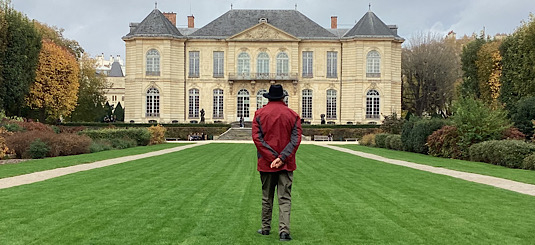
How different things are in France: there, walking on public lawns is so often forbidden. Faced with this senselessly restrictive rule which deprives people of the pleasure of walking on grass barefoot or shod for years I have been tempted to take a few forbidden steps. And so it was that day. I told Rohan of my plan and after she had made herself scarce, and well aware that I started my walk across a magnificent forbidden lawn behind the Musée Rodin (see illustration). No one told me off and whether there were some observers who were envious I know not.
Challenges have the power to change people’s ideas and customs. Hopefully my two challenges in Paris, which in the big picture can be seen are tiny, even petty events, might encourage others to do the same.
The illustration shows me walking on the lawn at the back of the Hotel Biron, a mansion in the centre of Paris built in 1732 which now, as the Musée Rodin, holds thousands of works by August Rodin together with the occasional work by colleagues.
For helping me write this blog I would like to thank Alan, Cam, Rohan and Vivien.
 The Joe Collier Blog
You’re an inspiration, Joe !
LikeLike
Dear Andrea, Thank you for your kind comment but of course, you are an inspiration. Love, Joe
LikeLike
For as long as I’ve know you, questioning and challenging is so you Joe; as you say, it’s what you’ve had to do as a teacher and researcher. My observation is that nothing will change if we don’t question, particularly in policing trust, confidence and legitimacy is fundamental. Joe for me, you remain forever curious and in touch with the ‘little boy Joey’, and that’s what makes you special.
LikeLike
Dear Carolyn, Thank you for your kind and thoughtful comments. You too are someone who challenges which I appreciate greatly. Love, Joe
LikeLike
Dear Joe,
Your continuous search for truth is admirable even if I guess that not all the subjects of your enquiries may have welcomed the enlightenment you offered: that’s there loss. As a much wiser man than me once said, “a life unexamined is not worth living.”
LikeLike
Dear Alan, Thank you for your for your comments. If the subject of any enquiry was wrong they should welcome someone helping them discover the truth. And who does examination of the life – the person themselves or a third party. I certainly believe we should be examining ourselves all the time. Yours, Joe
LikeLike
Enjoyed blogXSent from my iPhone
LikeLike
Dear Joe,
I admire your challenging stance- it is so important in life and I try to do so myself but often cause trouble when I do! I imagined the two French policemen going back to their barracks and describing the strange Englishman who actually spoke to them!
No doubt you have heard of Senator Lydia Thorpe who challenged Kind Charles when he was here recently. She is aboriginal and was greatly criticised for her manners, but I thought what she did was important. She has continued challenging both inside and outside government.
Keep it up!
Love
Robin
LikeLike
Dear Robin, Thank you for your comments.Like you, I thought that Lydia Thorpe’s intervention was wonderful. What a brave woman. Perhaps she be nominated ‘Challenger of the year’? Love, Joe
LikeLike
Good for you Joe, it’s always good to challenge rules and conventions rather than blindly obeying. Only recently I was walking along the towpath at the back of Hampton Court Palace with my amiable and placid Labrador, Meg, when a grumpy person pointed to a sign attached to the railings and asked me if I could read. The sign said ‘Dogs must be lead’, with no explanation as to why. I pointed out that a lead dog would be far too heavy and carried on my merry way.
LikeLike