This blog stems largely from something I have puzzled over for years and which arises when I am out walking in the French countryside. It is all about the way people behave when they meet ‘strangers’.
A favourite path of mine starts just near our house in Brittany. It is usually empty but sometimes when walking I might just make out a tiny figure in the distance, perhaps three hundred metres away, which I then watch as it gradually draws closer. What happens next seems programmed into us and is of enormous importance. If I am alone and the stranger is now close, we look one another in the eye and then, still looking, we smile, nod approvingly and finally exchange ‘Hellos’ or perhaps a little more. Then we both walk on, probably never to see each other again.
Somehow, that fleeting moment in which we seem to ‘formally’ acknowledge the existence of one another as harmless fellow human beings is essential, powerful and oddly emotional. And while it is not possible to measure the level of feeling that such a meeting generates, some idea of its effect can be gauged by what happens if the converse occurs and the stranger does not ‘engage’.
Very occasionally, an oncoming stranger walks straight past without saying a word, without looking and without making any gesture of acknowledgement. By the absence of those simplest of welcoming gestures I, for one, am made to feel uneasy, suspicious, even denigrated, as though an unwelcome alien or enemy! When this occurs, I might well look back to check that my passer-by has really gone!
Although it may sound fanciful, I now believe that our behaviour on these occasions has origins that date back hundreds of thousands of years to the beginning of the first gathering of Human Beings 200,000 years ago. Why else would rituals on meeting and acknowledging strangers be so universal and carry so much meaning. Somehow, over millennia these mechanisms have become bound into our fibre.
Whatever their origins, it seems to me that something akin to the magic that arises when complete strangers meet on a country path also occurs with chance meetings in towns. Living in London in a leafy suburb with neither a car nor a bike means that whenever I go out, part of my route will take me along quiet, uncrowded pedestrian paths. Just like in the French countryside, most days I meet strangers whose presence demands acknowledgment. Sometimes it is eye contact, a smile and the equivalent of ‘Bonjour’, sometimes there is more as I make some passing comment. So to someone looking lost it might be ‘Do you need help?’, or to a dustman or road sweeper it would be a ‘Thank you’. In any case, a brief exchange may follow but rarely more.
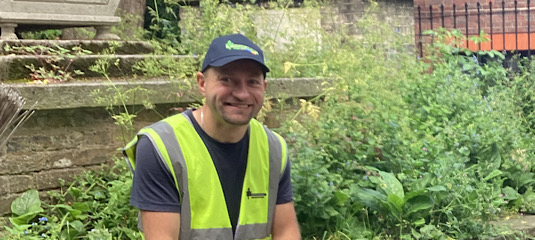
Obviously some one-time strangers become people I see again and again and this has been the case with the man who sweeps the roads and paths around a local churchyard. I now see him most days as he sits on a wall with his back to a large chest tomb in the churchyard (see illustration) enjoying his mid-morning coffee and bun. After a year or so of smiles and nods I tried to chat, but there was a problem; Andriy, as I discovered, is Ukrainian and speaks almost no English.
Just recently, and now knowing what he spoke, our relationship has improved as I have been able to take advantage of the four Russian words I have learned at home. I can say ‘hello’, ‘good bye’, ‘fine’ and ‘thank you’ which I use when I open the front door for Rohan’s Russian teacher when he comes to give her lessons. With Andriy there are nothing but smiles as we repeat to each other ‘privet’, ‘do svidaniya’, ‘khorosho’ and ‘spasibo’. Moreover similar single-word communication was probably used by our ancestors all those years ago.
Interestingly, while acknowledgement between strangers is usually a matter of happenstance, in certain circumstances such behaviour is formalised. In restaurants in France, when people sit down at a table they automatically turn to those already installed at neighbouring tables to nod and say ‘Bonjour’; saying nothing would be seen as the height of rudeness.
The illustration is a photo of Andriy sitting at his morning coffee spot in the local churchyard.
For helping me write this blog I would like to thank Andriy, Stephen, Rohan and Vivien.
 The Joe Collier Blog
Dear Joe,
This certainly speaks to my experience when I walk. I think, because I’m in a big city, people have stopped acknowledging each other. I no longer drive so walk or take public transport most places. I try to say hullo as I pass people-some look shocked but say hullo. Often though, people are wearing ear buds and are absorbed in what they are hearing so tend not to make eye contact and so I don’t say hullo. A bit sad. I wonder if your experience in large cities versus small towns is very different
Love
Robin
LikeLike