
As a child I missed out. While everyone else in the family has had a Teddy Bear or the like, I haven’t. For my younger sister it was ‘Wonkey’, a koala who she held as she went to sleep, for Rohan it was ‘Teddy’, a large Teddy Bear that, as a three-year-old she brought to London from New Zealand and then later, when five, took on to Paris, and for our three boys it was ‘Man’, ‘Monkey’ and ‘Sunny Jim’. For me, it was my thumb, and despite umpteen parental reprimands and warnings of future teeth deformity, I used this natural ‘comforter’ to help me each night. It is perhaps because I felt bereft, that nowadays I identify strongly with children I see clutching their ‘transitional objects ’, and it is three lost Teddies that inspired this blog.
The first loss was in Richmond. We take the same route each day when we walk to the local sports centre – Rohan to the pool, me to the gym. On one morning last February, we read the saddest news. A poster pinned to a tree announced the loss of a much-missed Teddy Bear that had been stolen from the family car. No name was given, just a photo of the Teddy together with an address to contact if the bear was found (see first illustration). After two months the poster was taken down and I assumed that the owners had given up.
Now to last week when, all of a sudden I was reminded of that Richmond poster and the request it made to any finder. I had just seen a second ‘Bear’ poster, but this one was on a lamp post not in Richmond but in Tréguennec near our cottage in France. It showed a photo of a found Teddy with the words (in French) ‘To whom do I belong?’ (see second illustration). I know that Teddy Bears are cuddled worldwide but a preposterous idea arose: could it be that the Teddy found in Tréguennec did not belong to a French child but was the one that had been stolen in Richmond and had been brought over by English holiday makers and fallen out of their car?
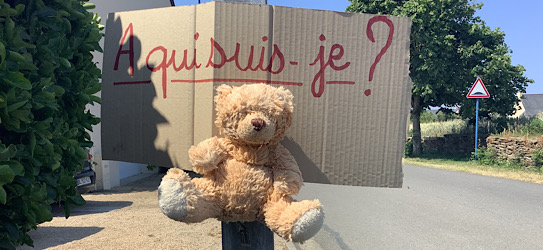
My suggestion was met with disapproval – Rohan argued that the bear in the Tréguennec picture was nothing like the one we saw in Richmond. I agreed but felt that after a 700 km journey and months of further usage with much hugging, it would be surprising if they looked alike. Clearly I needed to know more.
As it turned out my enquiries got nowhere. Next day the Treguennec poster had gone and as I was not sure on which lamp post the photo was attached and outside which house, I had no way of knowing which door to tap on to learn more. Similarly, I discovered nothing when I emailed the Richmond owner – a recorded message said that the address I had used was now deleted!
Now to the third lost Teddy. While the use of Teddies and the like usually stops by the time the owner is around eight, some are kept and treasured by people well into their adulthood. That was the case in this instance.
A year ago, when flying to France, I found myself chatting with a man sitting across the aisle. Throughout our conversation he remained eerily still and the reason was soon revealed. Nothing serious – it was simply that the woman next to him was asleep with her head resting on his shoulder! Soon she woke and immediately searched frantically through her pockets, her hand bag and around her seat. She had, I was told, lost her Teddy. As it turned out, her missing Teddy – now pale and virtually hairless – had fallen under the seat in front.
Some insight into the lasting powers of a Teddy soon followed. My neighbour told me how he had only recently married his neighbour, and that when they were courting she had told him that if they married there would be a condition attached – he would have to play ‘second fiddle’ to her Teddy who had been her constant companion for forty years; it would certainly accompany her on plane journeys. Clearly he had agreed!
Childhood ‘transitional objects’ such as Teddy bears are very important, so much so that they remain in people’s memories even in their dotage. Depriving children of one, which happens in some families, seems so very unfair. At the same time, plans need to be made about what to do if one goes missing!
The first illustration is a photo taken four months ago announcing the loss of a Teddy Bear. The poster was pinned to a tree near our home in Richmond. The second photo, which was taken last week, shows a poster of a Teddy Bear found in Tréguennec; the message reads: ‘To whom do I belong?’
For helping me write this blog I would like to thank Sarah, Elona, Rohan and Vivien.


Hello Joe, I enjoyed reading your blog and wondered whether teddy bears are mainly a white Western (British/American/German) thing, and as you suggest the lost and found teddy might have been from a tourist. I’m not aware historically of any of my friends or extended family from black and visible minority communities having a wonderful comforting and transitional friend.
LikeLike
Dear Carolyn, Thank you for your comments. The question of country Teddy Bears or some comforter is important as is your own experience and that of those close. From my reading of the Web, and so when I wrote the blog, they are used world wide but not necessarily as ‘Western’ cuddly toys but home, or locally made, equivalents. That is as much as I know. love, Joe
LikeLike
Dear Joe
I’m suprised that you feel you missed out on having a teddy bear, as if you were deprived of one, rather than just not bonding with one. I have no memory of having a special teddy. Of my three children, the oldest did not become attached to a particular soft toy, whereas the other two still own an ‘animal’ from their childhood that is still very precious (a crocodile in the case of my daughter, a penguin for my son). I wonder why it is that people can be different in their attachments to such things.
LikeLike
Dear Andrea, The issue for me is that Teddies and the like seem to help children to develop, particularly as they become independent and as they learn generally. It is just that I know how those close loved their Teddies or equivalents and while I might have rejected offers (my fault!) I never had the obvious advantages they could have provided. It is all rather complicated. Love, Joe
LikeLike