Over the years, I have grown closer to animals. When the children were young, I was rarely drawn to talking to, picking up or cuddling the family’s pets; for me just patting or stroking were enough. In keeping, animals outside the home went essentially unnoticed. With age I have changed: as an older man I cried each time a close pet died and now I love seeing birds when they land in our garden – if a robin perches nearby when I am gardening, I find myself saying ‘hello’ – and the same goes for a passing squirrel or stray cat.
My feelings towards animals in televised nature programmes have also changed. For years, and despite wide acclaim, the earlier ‘epics’ using the latest camera technology and photographed in the most exotic of environments would leave me cold. And this position was not helped by the repeated close-ups of animals fighting and killing. Moreover, my antipathy was not helped when the accompanying narration was, or so often it seemed, in a language that was quasi-ecclesiastical and unnecessarily peppered with superlatives – ‘best’, ‘first’, ‘largest’, ‘longest’ – words that really didn’t help!
Watching ‘Nature’ programmes did get easier when the BBC started transmitting their unpretentious and charmingly spontaneous ‘live’ nature programmes – Springwatch Autumnwatch and Winterwatch – which I found compulsive viewing, but for years these were the exception.
This blog, however is about the latest step, a recent ‘conversion’. I was introduced to ‘Kingdom’, this year’s nature ‘epic’ on the television, which I have watched and enjoyed immensely. Importantly, and to my surprise and delight, I found myself identifying for the first time with the various animals whose stories were being told. Moreover, in the various episodes, intimate details of the final stages of hunts were rare and shown with discretion.
I only discovered the series as a result of Rohan’s persuasion – unlike me, she is a devotee of nature films. Rohan loved it and by taking advantage of the TV’s replay facility, arranged for us to sit together and watch all of the key episodes. The principal animals in the series had names, and because Rohan had become familiar with them all, she was able to help me with the story when I lost track.
Kingdom, which took five years to film, was shot in Zambia in the Nsefu Sector of the vast South Luangwa National Park. Living in the Sector, which measures 226 kilometres square – around twice the size of the Isle of Wight – are four established families of carnivores and the film is about them and how they relate to one another. Here, a pride of lions, a clan of hyenas, a pack of wild dogs and two leopards – who tend to live alone – all compete for the same food (mainly deer and buffalo, with the occasional baboon or bird) and ultimately what they eat depends on hunting and stealing. The goal of the series is to see which group will ultimarely dominate the patch.
During the series many other animals feature but these play only peripheral roles. Giraffes, elephants, hippopotomi and rhinoceros were not involved because all are herbivores, while birds, monkeys and lizards were ignored since their roles in the food chain are minor. Crocodiles, however do feature because they were a constant threat to the wellbeing of the members of the four families whenever they crossed rivers.
What then was endearing? Over the series I became attached to Flint, a wild dog who had lost a leg in a trap, and who is looked after and fed by the pack. Flint acts as nanny to the pack pups when the others go hunting and is then mourned after his death as the result of a clash with a crocodile. I also identifed with the three adult lioness sisters who hunt together, flirt together with two reticent lions, then together walk and play with the resultant cubs. l also shared the pleasure shown by Olimba, an elderly solitary and most beautiful female leopard who finally has a cub who will keep her dynasty going. Finally, I learned to dislike the hyenas who seemed to do nothing but steal and sneer.
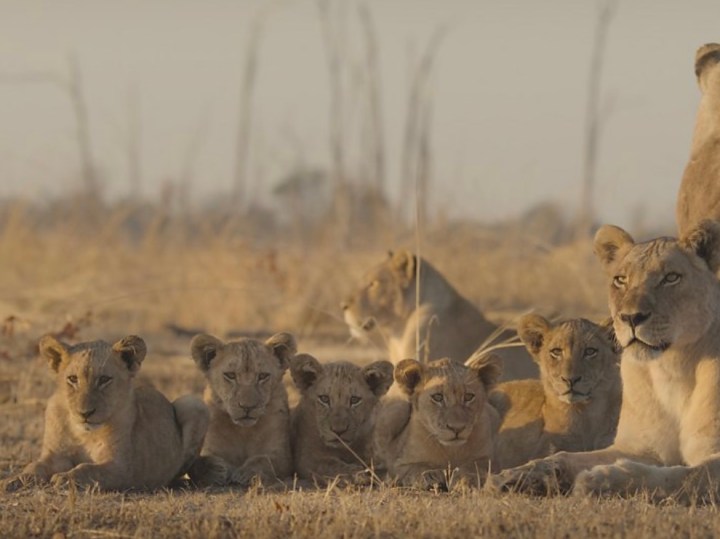
And which family won? At the end of the series, it was declared that the next rulers of the Nsefu Sector Kingdom would be the lion pride and moreover, they were so dominant that their reign would last for years. Importantly, having watched the series the outcome felt justified and deserved. Moreover with Rita as the leading lioness of the pride, plus her two sisters and their eight cubs, the Kingdom would be in good hands.
The illustration shows a ‘still’ from ‘Kingdom’ in which five of the lion cubs are sitting alongside Rita, and in front of one lion.
For helping me write this blog I would like to thank Jacky, Julian, Terry, Rohan and Vivien.
 The Joe Collier Blog