This story is about two fields near our house in Tréguennec. In one field, the image I saw first brought warmth and fascination but with changes these turned to feelings of sadness. In the other field, the picture was one of widespread and disturbing destruction. Inevitably, in all I saw emotion and imagination will have played a part.
Tréguennec is a tiny village with no shops and on most days we drive to Ploneour, the town nearby, to buy our provisions. On the way there, the road winds its way past small fields each planted with its own crop. When we arrived at the start of our French summer, the field at the bottom of the hill just before Ploneour had been left fallow and as we drove past we could see across the field and even scan its far edge along which was a spinney.
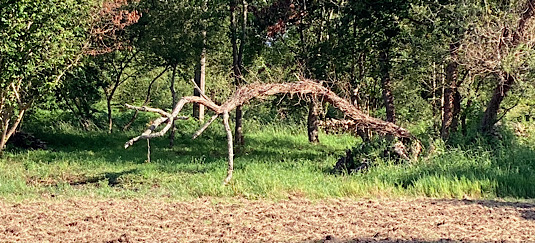
With each trip I built up a picture and soon I had pieced together the image of a diplodocus, an extinct prehistoric dinosaur with a very long neck and tail, as it walked out from between the trees (see first illustration). I love dinosaurs and there in the distance I had managed to find one. To check what I was seeing, on several occasions I parked the car next to the field to give me time to look, and twice I walked across to my dinosaur to check the details; my treasure with its large head and big eyes was created by the trunk and branches of an uprooted, leafless tree. Importantly, despite my research and increasing knowledge, to my eye the structure remained very much that of a dinosaur.
Soon I would look forward to seeing my dinosaur each day as I drove by, but then some weeks later it suddenly disappeared – over one night it had gone. I presumed that it had begun to interfere with the farmer’s business so now all that remained was a pile of sawn logs – the monster’s erstwhile bones. Seeing an emptiness with little tangible except a pile of logs was very sad!
I told several friends of my ‘Tréguennec dinosaur’ and on finding it they could not believe that they had missed it. They did however notice when it was taken down and, like me, some even felt its absence.
Now to my second field and the destruction I saw that was so disturbing. Whether or not we drive to the shops, almost every day we do go for a walk. Each time we follow the same ‘circular’ route that takes us by a narrow road up a hill behind our house, along a grass track, then back to a second road and down the hill and home. At the top of the hill that day we met a glum looking neighbour whose garden had once again been dug up – wrecked – by wild boar. ‘Nowadays they are everywhere. Have you seen the field they have just wrecked down the lane?’ That field happens to be on our walk and on the previous day it had been its pristine self.
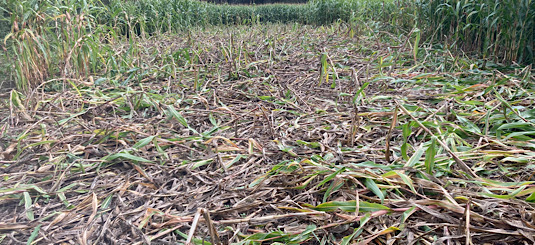
Following Rémy’s advice we had a look at the field and towards its centre we could see a vast, tennis-court sized area where the once two metre high maize was now trampled. In addition the earth was dug up and everywhere chewed maize corns were hanging from stems or laying on the ground (see the second illustration). We assumed that in a few hours overnight a sounder (a herd) of wild boar had done the damage. Moreover, a day or so later we discovered that they returned and the damaged area was twice the size!
Just looking at the damage done by the wild boar was chilling. What the farmer feels must be much worse. And it seems that little can be done as the number of animals is rapidly increasing. Indeed, while twenty years ago locals tell how wild boar around Tréguennec were rare, estimates suggest there might now be hundreds. Moreover, farmers and hunters have a problem finding a coordinated solution. It seems that undertaking controlled culls is difficult.
Being moved or amused by images is a standard part of the human condition. Why a dead, fallen tree, a pile of cut branches and an area of dead crushed maize could have such different effects is interesting. Clearly in imagery, emotion plays a most important rôle.
The first illustration shows my ‘Diplodocus’ walking out of the forest. The second illustration is a photo of a maize field with an area larger than a tennis court crushed overnight by a sounder of wild boar.
For helping write this blog I would like to thank Jean-Claude, Annie, Alain, Rémy, Carolyn, Rohan and Vivien.
 The Joe Collier Blog
Hi Joe, I was worried at your intro that the destruction was man-made. Does it feel better that it was caused by wild boar taking control of their habitat? Probably not from the farmers perspective? Also, is ‘sounder’ the collective noun for boar? Thanks as always for a thought-provoking blog x
LikeLike
Dear taracb96, Many thanks for your comments.I apologise for your initial worry -that was never my intention. You make an interesting point – the idea that they are simply claiming back what rightly theirs had not occurred to me. A ‘sounder’ is a group/herd of wild boar.
Love, Joe
LikeLike
Dear Joe, they say seeing is believing and the unique, neat and football pitch style of devastation was fascinating to see. I am curious if anyone has seen the wild boars in action, seems a bit like a case of the Loch Ness monster… perhaps,
LikeLike
Dear Carolyn, thank you for your comment and welcome back. Wild boar leave tell-tale traces of any visit some of which we have found in earth turned over in our Treguennec garden. It is these traces, which are a regular finding, which are the giveaway.love, Joe
LikeLike