This blog starts with some observations about colour. More precisely about two birds whose feathers are of the brightest colours though seeing them in their full splendour has proved difficult.
For years I had assumed that there was nothing in nature more colourful than the iridescent blue of a kingfisher. Rohan and I have twice seen kingfishers and on both occasions we were staring dreamily across streams – once in London, once in the West Country. Suddenly we saw a flash of the shiniest blue as each appeared from out of the reeds and swept across the water just in front of us.
I knew a little about kingfisher colouring from photos and this was most helpful. When seeing them in nature everything was dominated by the blue and it was thanks to the photos that I could ‘see’ the birds differently and in more detail. Because they moved so fast I had completely missed many of the birds’ features, in particular the bright orange feathers of its belly and breast.
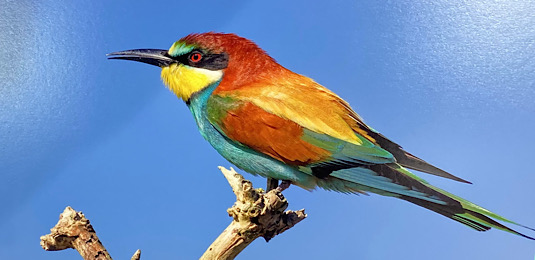
Photos have now allowed me to make sense of bird colours once again. This time it was not those of the kingfisher but of the extraordinarily colourful guêpier (wasp eater), a most beautiful bird which spends its summer months near our cottage in France. Like the kingfisher, its colours are clear and bright (see illustration), but on its feathers the range of colours is that much greater. It is difficult to imagine a prettier bird, but what is extraordinary is that I only really know their full beauty by piecing together the colours I have seen in photos. For around five years I have been trying to see this bird’s colouring but so far it has proved elusive.
My knowledge of birds is actually very limited although my interest generally has been increasing since my retirement almost twenty years ago. In my observations I have developed a ranking. Except for pigeons, which I dislike intensely, I see birds as ‘friends’ with some closer than others. Sightings of everyday birds such as blackbirds, sparrows or starlings are registered but soon forgotten. With their enchanting colouring, chaffinches, blue tits and goldfinches on the other hand, I could stare at for ‘hours’; I will try to bring them to the attention of anyone nearby. Robins are different again; their smudged red breast is appealing, but it is their cheeky demeanour I like best as they seem bent on ‘engaging’ in conversation.
Now, it is the European guêpier that is top of the list. After flying in each year from Southern Africa, many of them spend the summer months – late spring to August – in the sand dunes near us in France. Knowing of their photographic reputation as the most colourful of birds, for the last five years I have been ‘on the look-out’, but I am still waiting to see the full spread of colour on any one occasion. This summer, for instance, I have had only three sightings. Once it was the red and yellow colouring that flashed by from out of a hedge just near our house. Another time it was more the blue as one flew off from its perch high up on a roadside telephone wire. Then on one of the three occasions that I sat in the hide of a local nature reserve I saw two perched on a fence some 15 metres away. But with their backs to the sun all I saw were shadowy blue-green bellies. Why it is so hard to spot what I know to be their real colours is baffling, and seeing a complete display has become a goal for next year.
They have not always been residents near Tréguennec, but with global warming they have ventured further north in search of their insect diet. In the 1980s, the French branch of the guêpiers was spending its summer months in the sand dunes on the Mediterranean coast. By the 2000s, as they pursued their much needed supply of wasps and the like, the birds started nesting in the dunes further north and near us in Tréguennec.
By 2040, I imagine they will cross the channel in sufficient numbers to be seen as established summer occupants of UK sand dunes. For birds which can fly 500 km a day, such a change is certainly possible. There are already some regular guepier sightings in the UK although here they go by a different name. In the UK they are called ‘bee-eaters’.
Imagine the treats of colours provided by kingfishers and guêpiers when they become close neighbours in the UK countryside. Global warming is not all bad – what an astonishing sight the two would make.
The illustration is a photo of the magnificently coloured European wasp eater. The picture was taken in the sand dunes near Tréguennec by Patrice Touzeau.
For helping me write this blog I would like to thank Jeni, Yves, Patrice, Rohan and Vivien.
 The Joe Collier Blog
Dear Joe Thank you for writing about this bird. I have seen what I know as a bee-eater only once, 30 years ago in the south of Spain. It was exciting to see. I remember seeing several of them at once. I don’t know if that is their usual habit.
LikeLike
dear Andrea, Many thanks for your comments. You are so right, the sight of a bee eater will stay for ever. As I understand it they come up through Spain on their way to more northerly countries. Some will actually go no further! Love, Joe
LikeLike
Dear Joe,
Everyone ought to have a favourite bird. Mine is the hoopoe after seeing a photo in a book last century. I had never seen it since – it is rare visitor to the UK – until I wandered from a hotel in Toulouse along a footpath some twenty years ago and there it was. Standing on a grass verge ignoring me, in full colour pose and displaying its extravagant punk-like head crest.
Its scientific name is ‘upupa epops’ which suits it perfectly and I wish I had excitedly exclaimed this on my one and only sighting.
LikeLike
Dear Alan, can we sing the ‘upupa epops’ song when we next meet for coffee. I expect you are a master. Yours, Joe
LikeLike
dear Alan, Can we sing together the ‘upupa epops’ song when we next meet for coffee? Obviously we will also need to do the actions of which you must now be a master. Yours, Joe
LikeLike