As long as I can remember I have loved fish – eating them that is! As a young child they were specially prized as during the Second World War and for several years after fish was one of the few tasty and nutritious foods that were not rationed. Dover sole was amongst my favourites, as indeed it is now!
My love for fish continued into my adulthood but I had no idea that for years I was being cheated. By happenstance the fish I ate was bought in London, and only since my retirement, which has meant living for much of the year in Brittany, have I discovered how fish can really taste. This blog is about my ‘new’ fish experience which has come thanks too the presence of a giant fish counter at the back of a ‘Leclerc’ supermarket close to our home in Tréguennec.
Living my summers in Finistère, I have learned how Bretons who live near the sea are choosey about fish which makes them very discerning customers. Accordingly, anyone selling fish that is not of the highest quality might struggle to stay in business. It is to this expectation that our local supermarket has responded.
Importantly, the Leclerc chain, which started in Brittany, prides itself on using locally sourced products, so the fish it sells is bought each day (save Sundays and Mondays) either at the early-morning or the afternoon fish auctions (‘criées’) at the four large fishing ports dotted along the coast a few kilometres away. Accordingly, the fish our Leclerc sells will have come ‘straight off the boats’.
Once brought back to the shop, the fish, crabs, lobsters, and prawns etc are displayed along a 20-metre, ice-covered counter to be served to its 1500 customers each day by over a dozen fishmongers. Importantly, almost all of the fish are sold whole and can be checked for their freshness before buying; I follow the rules that fresh fish have bright red gills, clear bulbous eyes and keep their shape on the slab (ie, no hint of being floppy!). Obviously, none of these signs can be checked in a filleted fish!
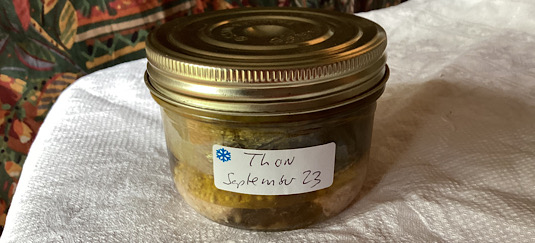
This blog was actually inspired by two recent meals each with elements unthinkable in London; in one, we ate sole whose taste was unmatchable. In the other, with a salad niçoise, we ate home-preserved tuna (see illustration) that we made from a fish we bought whole almost a year ago.
There is always a queue at the fish counter but by arriving ten minutes or so before it is our turn we get a chance to look at the twenty five or so types of fish on display and can start to make a choice. After some discussion with the fishmonger we were offered two of the most perfect soles and that evening we fried them in butter and ate them sprinkled with lemon juice and served with carrots and new potatoes. With their beautifully firm flesh and distinctive ‘sole’ taste, each mouthful surpassed any London-bought fish. It was a treat to behold and to taste.
Now to our preserved tuna. Each year in early autumn boatloads of white tuna are landed in the local ports with handwritten notices appearing on trees and lamp-posts announcing ‘Arrivage de thon’. It was in September last year that we bought ours. At one point along the counter there was a mountain of tuna and when we got to the front of the queue we simply pointed to one of the larger ones and the process began. Each fish weighs 6-8kg and for bottling it needs to be in cut into slices, not an easy matter. The fishmonger asked what thickness the slices should be and I took my lead from a elderly woman nearby. She ordered three tuna with slices 4.0cm thick, and I did likewise for my one. In minutes my newly sliced tuna was passed back to me.
Next day bottling started and for two hours Rohan and I worked as a team, adding in turn to our preserving jars: boned portions of tuna that had been soaked overnight in salted water, olive oil, cloves of garlic, some thyme, a bay leaf, some pepper corns and a slice of lemon. Then, after a complicated sterilising process the bottles were stored, not to be opened for at least three months. The preserved tuna we had that night in the salad Niçoise some nine months later was absolutely delicious. But importantly, it would have been impossible to create such a taste in London where buying and preserving a whole, fresh-caught tuna would be out of the question.
What with the sole and the tuna and all of my other Breton fish delights, I have discovered tastes that have been known by my French neighbours for years. Sharing these with them has been a dream!
The illustration shows a jar of our home-preserved, locally caught, Breton white tuna (‘thon’) bottled last year.
For helping me write this blog I would like to thank Thibaut, Armelle, Rohan and Vivien.
 The Joe Collier Blog