Recently we had a week dominated by insects. Other animals made appearances, but it was insects on which we concentrated and which captured the interest of our nature-loving guests, one of whom was an encyclopaedic ‘seeker/explorer’; the other more a dedicated ‘watcher/observer’. In keeping, Jeni would excitedly show us photos and tell stories of the butterflies she had found during sorties into our meadow, many of which had become very uncommon around her home in Devon. While it was Jackie who found an Asian hornet’s nest in one of our trees. This blog is about their different ‘insect’ discoveries.
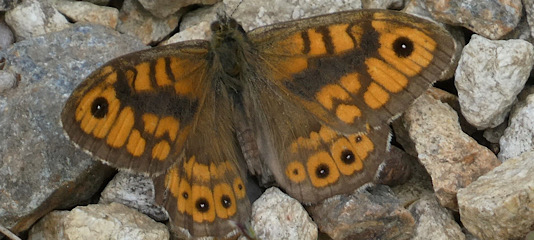
First to butterflies which, in the UK are in a perilous state. The picture is alarming – sightings of many native butterflies have plummeted since the 1970s, and, worse still, half of those that remain are at risk of extinction. Intensive farming with the loss of hedges, woods, wetlands and meadows, the use of insecticides and herbicides, and the recent hostile climate changes have all taken their toll. Now, butterflies that were once common in the UK are rarely seen, with any viewing greeted with celebration. In our French garden that week such celebrations were common, as in addition to the everyday butterflies, Jeni saw tens of walls (see the first illustration), small heaths and one late-flying white admiral, all of which have become hard to find over the Channel.
Why are things so very different in our cottage? It happens that here we are surrounded by woods and streams which in France are protected ‘by decree’ and by fields that are insecticide-free. In this environment, the overgrown meadow at the foot of our garden has become an insect haven which made exploring a delight for Jeni whose enthusiasm was infectious.
Now to the discovery of the nest of the notorious Asian hornet. The problem is that these particular hornets kill bees and have contributed to a dearth not only of those bees that work to make honey, but also the umpteen individual bees who pollinate the countryside’s flowers, crops and trees. What with insecticides, herbicides and infection, the population of bees is already threatened and the Asian hornet has made things that much worse.
As a result of local and national campaigns and articles in the media, farmers, naturalists and local authorities are very aware of the threats posed, nowhere more so than in France where the insect arrived in 2004 and is now everywhere. In the UK they only arrived in 2016 but are already taking a hold.
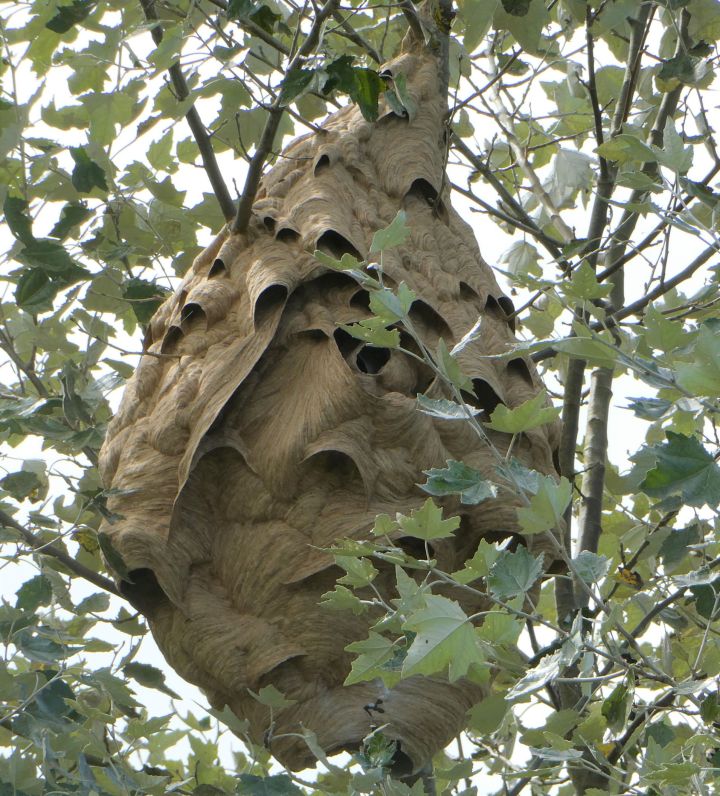
Jackie spotted the nest by chance. We were walking in our meadow when she suddenly noticed a large, grey, tear-drop shape the size of a tea towel hanging high in one of our trees almost hidden by leaves. Although she did not know exactly what it was, she feared that we were playing host to an Asian (or yellow-legged) hornet colony, a position soon confirmed using binoculars when we saw a surface covered with scrambling hornets – it was indeed a nest and one very much alive.
Next morning we told the Town Hall of our discovery and were given the name of someone who would kill the colony. We were also told to keep clear – when aroused they sting. Indeed, word has it that they are vicious, sting more painfully and kill people, although the UK government’s line is that they are no more of a threat to humans than are native hornets and wasps.
Within hours, the hornet man arrived, told us what he would do and ushered us away. The process is straight forward; he fills a large can with a poisonous powder, pressurises the mixture and attaches the can to an eight-metre long pipe that ends in a sharp metal tip which he steers into the nest. Then, with the press of a button the poison ‘explodes’ into the colony. We were assured that in fifteen minutes the nest’s inhabitants would die while any hornets who return from foraging would pick up the poison and die later. Next day we ventured closer and what was once a busy home to thousands of hornets could now be seen as a beautifully designed and constructed morgue (see the second illustration).
During the week I learned of the contrast between, on the one hand populations of beautiful butterfly species whose survival is threatened and where seeing one is celebrated, and on the other vicious and thriving invasive hornets who are being actively sought and extinguished. And there is a twist. Three days after the hornet’s nest had been ‘treated’, Rohan found one of them with its tell-tale yellow socks walking drowsily amongst some fallen apples. These damaging insects are survivors!
The first illustration is a photo of a beautiful wall butterfly now uncommon in the UK. The second is one of the Asian hornet’s nest after its builders and inhabitants had been exterminated. Both photos were taken by Jeni
For helping me write this blog, I would like to thank Jeni, Jackie, Rohan and Vivien.
 The Joe Collier Blog
Hello Joe Thank you for writing about insect life. The decline in numbers and variety is alarming and made worse by the arrival of invaders. Thank you for including a picture of the Asian hornets’ nest. I assume from the way you have written that it is characteristic and easy to distinguish from the nest of native hornets?
LikeLike
Dear Andrea, many thanks for your comments. The sharp and style of the Asian hornet’s nest makes it easy to identify ; up to a metre long and tear drop shaped, and hanging in trees around 8 metres off the ground. Love, Joe
LikeLiked by 1 person
Dear Joe,
The reminder of the collateral impact of demands for cheaper food via diminishing insect life is most welcome: it’s easy to lose sight of the heavy price being paid for this.
The accompanying story of the Asian hornets equally emphasised the importance of protecting our bees and it was good to read about a successful sortie against this pest – every little bit helps. The picture of the resulting ‘mausoleum’ was striking.
LikeLiked by 1 person
Dear Allan, Thank you for you comments. Oddly enough, finding the live nest filled me with excitement, pleasure and apprehension. Killing them was right but full of conflicting feelings. Yours Joe
LikeLike
Another very interesting blog, where I have learnt about nature and what we have done to our natural world. The photograph of the empty hornet nest is strikingly unique, ugly and beautiful… what happened to the drowsy yellow socked survivor?
LikeLike
Dear Carolyn, Thank you for you kind comments. We never found a single dead Asian hornet although 3000 must have died, and the drowsy ‘yellow sock’ has not been seen again. Your choice of the word ‘ugly’ is interesting. The intrinsic beauty of the nest is lost thanks to connotations. Love, Joe
LikeLike
Dear Joe,
Thank you for another fascinating blog. What conflicts! The conflict of course between this invasive hornet species and the threat it poses to native eco-systems in areas of Europe and the UK. Yet what conflicted feelings too about having to destroy these living things (to save others) when it is clear they are such extraordinarily creative and industrious creatures. What a construction is that nest. Quite remarkable.
But as for the butterflies and other more welcome invertebrates – beautiful! It is a great thing that you have created space for nature and biodiversity on your land there in France. Long may that haven thrive.
Love, JJ x
LikeLike
Dear JJ, Thank you very much for your thoughtful and generous comments. Part of the ‘success’ of our garden must go down to our gardener who is an ecological fanatic and has not let anything be done in the garden that he felt was against the interests of the native animal and plant ‘wildlife’. I look forward to hearing what he thinks of the nest spraying when he returns from his holidays – he has been away for the last two weeks. Love, Joe
LikeLike
Another interesting blog. I’ve spent part of the weekend re-reading your first two books, In the Fullness of Time, and As I See It. It was especially wonderful to read all your entries on Brittany, which were made so much more vivid after our visit. Thank you, Marc
LikeLike